

When it comes to growing healthier plants and achieving better yields, light distribution is one of the most overlooked aspects of LED grow lights. Sure, people love to talk about things like power efficiency, spectrum, or PAR output, but if the light isn’t evenly spread across your plants, you’re going to face some serious problems—uneven growth, wasted energy, and lower-quality crops. So, let’s dive into why light distribution matters, the challenges in achieving it, and how modern technology is solving these issues.
1. What is Light Distribution?
Light distribution refers to how light emitted by a source spreads over a target surface. When it comes to LED grow lights, light distribution determines how evenly plants receive light across their canopy. Uneven light distribution can result in some plants receiving too much light, while others don’t get enough, leading to inconsistent growth and wasted energy.
1.1 The Role of LED Grow Lights in Modern Agriculture
LED grow lights have become a game-changer for horticulture and agriculture. Compared to traditional lighting systems like HPS (High-Pressure Sodium) or fluorescent lights, LEDs are more energy-efficient, customizable, and long-lasting. However, achieving perfect light distribution remains a critical challenge in maximizing their potential.
2. How Light Distribution Affects Plant Growth
2.1 The Relationship Between Light and Photosynthesis
Plants rely on light for photosynthesis, the process by which they convert light energy into chemical energy. This is heavily influenced by the PPFD (Photosynthetic Photon Flux Density), which measures the amount of light (in micromoles per second) reaching a plant surface. Uniform PPFD distribution ensures that all parts of the canopy receive the same amount of light, promoting even growth and maximizing plant productivity.
2.2 Consequences of Uneven Light Distribution
When light isn’t evenly distributed:
- Uneven Growth: Plants under intense light grow faster, while those in shaded areas lag behind.
- Wasted Energy: Excess light in certain areas is not utilized efficiently.
- Plant Stress: Too much light can cause overheating or photodamage, while too little light stunts growth.
- Reduced Yield: Inconsistent growth leads to lower-quality crops and reduced overall yield.
2.3 Industries That Rely on Uniform Light Distribution
- Greenhouses and Vertical Farms: Consistent light is essential for maximizing crop yield and quality.
- Sports Turf: Grass on sports fields must grow evenly to ensure durability and safety for players.
- Floriculture: Ornamentals and flowers are highly sensitive to uneven light, which can affect blooming and market value.

3. Challenges in LED Light Distribution
3.1 Natural Limitations of LEDs
LEDs typically emit light in a wide angle, such as 120° or 80°, without any secondary optics. This results in light intensity being highest directly below the light source and diminishing as you move away. This uneven spread is described by the Imax.cosΦ formula, which predicts that light intensity decreases with the cosine of the angle.
3.2 Common Problems in LED Systems
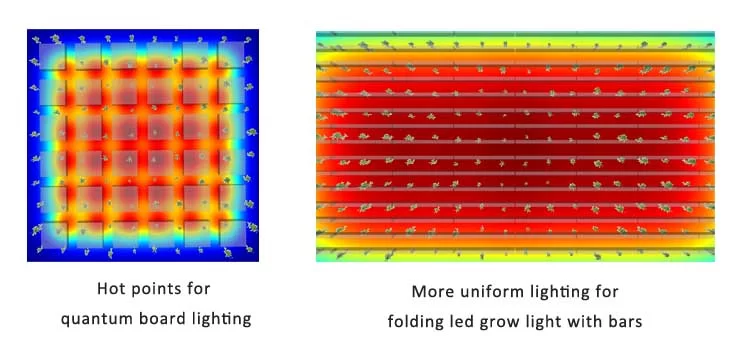
- Hot Spots and Dark Zones: Plants directly under the light get too much energy, while those on the periphery receive too little.
- Overlapping Light Fixtures: Placing multiple lights closer together can help balance light distribution, but this approach increases costs and requires additional infrastructure.
- Wasted Energy: Without proper control, much of the emitted light doesn’t reach the plants effectively.
4. Solutions for Better Light Distribution
The good news is that fixing light distribution isn’t rocket science—at least not anymore. With advancements in optical design and LED engineering, it’s now possible to achieve near-perfect uniformity in light distribution.
4.1 Batwing Design
One of the best innovations in light distribution is batwing design, also we called spider, or grow light bar, a spread out bar design that redistributes the light from an LED into a perfectly even spread. Instead of concentrating all the light beneath the fixture, batwing grow bar scatter it more evenly across the target area, eliminating hot spots and dark zones. With this technology, you can achieve up to 90% uniformity, meaning almost every plant in the canopy gets the same amount of light.
4.2 Total Internal Reflection (TIR) Lenses
Another game-changer is TIR (Total Internal Reflection) lenses. These lenses not only focus the light but also allow for more complex beam patterns, like rectangular or oval-shaped distributions, which are perfect for different growing setups. For example:
- Wide rectangular beams work great for spreading light evenly across a flat canopy.
- Narrow beams penetrate deeper into dense canopies, helping lower leaves get more light.
4.3. Diffuse Lighting
Diffuse lighting is another approach that spreads light more evenly by scattering it in all directions. Think of it like sunlight passing through a cloudy sky—it’s soft, evenly distributed, and reaches every part of the plant. In greenhouses, diffuse glass can be used to achieve this. For LED systems, special coatings or materials can mimic this effect.
4.4 Miniaturized Light Sources
Smaller light sources make it easier to shape and control light beams accurately. Compact LED modules combined with advanced optics can achieve highly targeted and uniform light distribution, even in challenging environments like vertical farms.
4.5 Heat Management
Achieving uniform light distribution often involves concentrating light in small areas, which generates heat. To prevent overheating, modern systems incorporate advanced cooling technologies like:
- Heat Pipes: Efficiently transfer heat away from the LED source.
- Passive Cooling: Reduces complexity and maintenance requirements while keeping temperatures stable.
5. Applications of Uniform Light Distribution
5.1 Greenhouse Cultivation
In greenhouses, uniform light distribution ensures that all plants, from the edges to the center of the canopy, grow at the same rate. Combining folding grow bar design can optimize light use and improve overall yield.
5.2 Vertical Farming
Vertical farms stack plants in multiple layers, creating challenges for light penetration. By using narrow beam angles and precise grow tube, growers can ensure that even the lower layers receive adequate light.
5.3 Sports Turf
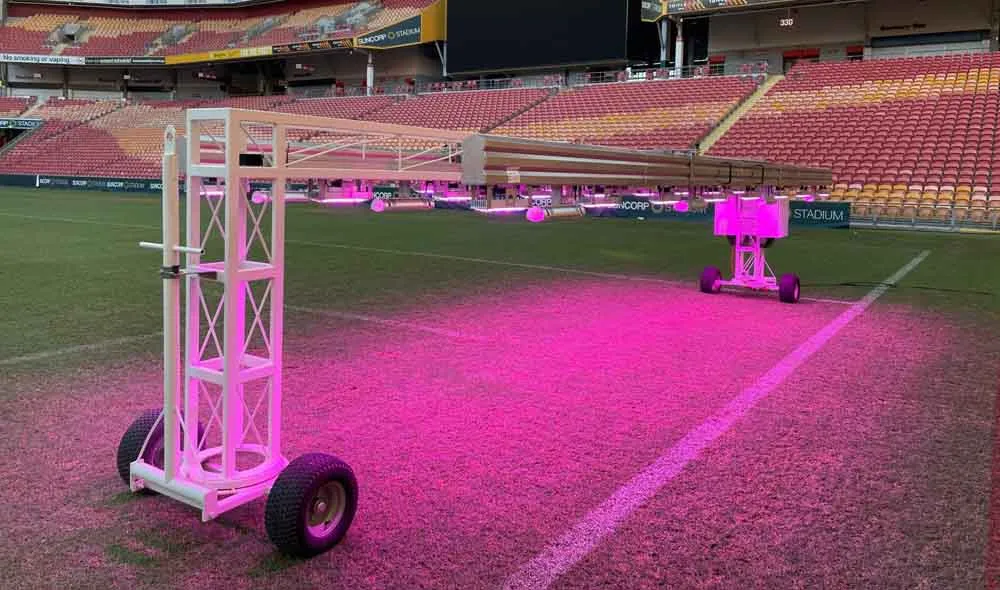
Usually the grow lights not install directly in the stadium. It’s usually install in a equipment. When it needs to grow grass or maintenance, move the equipment to lighting it.
5.4 Floriculture
Ornamental plants and flowers are highly sensitive to changes in light intensity. Uniform distribution ensures consistent blooming and higher-quality flowers, which are crucial for commercial success.
6. Future Trends in LED Light Distribution
What’s next for LED grow lights?
6.1 Smart Lighting Systems
AI-powered systems are being developed to monitor plant growth in real time and adjust the light distribution accordingly. These systems can dynamically change the beam angle, intensity, or spectrum to match the plant’s needs.
6.2 Adaptive Optics
Imagine a light fixture that can change its beam shape on the fly. Adaptive optics are making this possible, allowing growers to customize light distribution for different crops or growing stages.
6.3 Energy-Efficient Designs
As energy costs rise, there’s a push to make even light distribution more efficient. New materials, like nanostructured optics, are being explored to maximize light output while minimizing energy consumption.
6.4 Integration with IoT
Future grow lights will likely be part of a larger ecosystem, communicating with sensors, irrigation systems, and climate controllers to create a fully optimized growing environment.
Conclusion
Light distribution is a critical but often underestimated factor in the performance of LED grow lights. Uneven light can lead to wasted energy, inconsistent growth, and lower yields, making it essential to prioritize uniformity in any lighting system. Advances in optical technology, along with innovations in heat management and adaptive systems, are transforming the way we approach light distribution. As these technologies continue to evolve, the future of LED grow lights is brighter, more efficient, and better tailored to the needs of growers worldwide.
