
The interaction between light and plants is fundamental to plant growth and productivity. Light drives photosynthesis and influences various aspects of plant development, such as morphology, flowering, and nutrient accumulation. One of the most intriguing aspects of light is how its color and spectral composition affect plant growth. This article delves into the effects of different wavelengths, discusses how the color of light affects plant growth, and explores the potential of LEDs in horticulture and floriculture.
The Role of Light in Plant Growth
The Importance of Light
Light is a critical factor that drives photosynthesis, the process by which plants convert carbon dioxide (CO₂) into carbohydrates using light energy. This process occurs within the chloroplasts of plant cells and is essential for plant growth.
The Role of Different Light Spectra
The spectral composition of light, which includes blue, green, yellow, red, far-red, ultraviolet (UV), and infrared (IR) wavelengths, has varying impacts on plant growth, morphology, development, and flowering. Among these, blue and red light are particularly crucial for photosynthesis.
Photoperiod and Flowering
The duration of light exposure, or photoperiod, significantly influences the timing of flowering in plants. By controlling the photoperiod, growers can manipulate flowering to suit seasonal or environmental requirements.
Photosynthetic Efficiency and Pigments
The Role of Chlorophyll
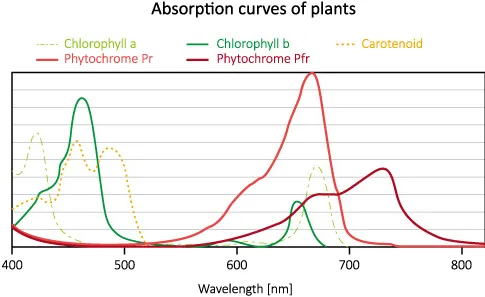
Photosynthetic efficiency is primarily driven by chlorophyll a and chlorophyll b, the two main pigments responsible for capturing light for photosynthesis. These pigments define the Photosynthetically Active Radiation (PAR) region of the spectrum, which is crucial for plant productivity.
Auxiliary Pigments
In addition to chlorophyll, other photosynthetic pigments, such as carotenoids (e.g., carotene, zeaxanthin, lycopene, lutein), act as antenna pigments that absorb light and enhance photosynthetic efficiency.
How Does the Color of Light Affect Plant Growth?
The color of light plays a critical role in determining how plants grow and develop, as different wavelengths have varying effects on photosynthesis and photomorphogenesis (light-driven structural changes in plants). The light spectrum for plants, which includes blue, green, red, far-red, UV, and IR light, impacts specific physiological processes. Here is the role of wavelength in plant growth:
General Effects by Wavelength Range
- 200–280 nm: Harmful UV light that damages plant tissues.
- 280–315 nm: Harmful UV light with minimal biological activity.
- 315–380 nm: May contribute to photomorphogenesis under certain conditions.
- 380–400 nm: Supports photosynthesis and plant development.
- 400–520 nm (Blue Light): Enhances photosynthesis and promotes vegetative growth.
- 520–610 nm (Green Light): Provides some photosynthetic support and aids vegetative growth.
- 610–720 nm (Red Light): Boosts photosynthesis, promotes vegetative growth, flowering, and budding.
- 720–1000 nm (Far-Red Light): Stimulates germination, leaf growth, and flowering.
- >1000 nm: Converts light energy into heat, with no direct impact on growth.
Blue Light for Plants at Night
Blue light (450 nm) supports photosynthesis and promotes compact growth by regulating leaf expansion. However, exposing plants to blue light at night may disrupt their natural circadian rhythms, as most plants require darkness for processes like respiration and energy storage.
Red Light (660 nm) vs. Far-Red Light (730 nm)
Red light (660 nm) simulates direct sunlight and promotes normal plant growth, while far-red light (730 nm) mimics shaded conditions, encouraging plants to elongate their stems to escape shade. However, this increased elongation does not necessarily translate to more biomass.
Spectrum Control for Flowering
By adjusting the ratio of red (660 nm) and far-red (730 nm) light, growers can influence the ratio of Pr and Pfr phytochromes, which control flowering time. This precise control enables growers to optimize flowering irrespective of seasonal changes.
By understanding these effects, growers can optimize the light spectrum for plants to achieve desired outcomes.

Optimizing Light Spectrum for Plants
Red Light for Growth and Yield
Red light (660 nm) is one of the most critical wavelengths for plant growth. It drives photosynthesis and plays a key role in flowering and fruiting. For example:
- Tomatoes and Peppers: Red light increases yield and improves fruit quality.
- Lettuce and Cabbage: Enhances pigment accumulation, such as anthocyanins and chlorophyll.
Blue Light for Vegetative Growth
Blue light (450 nm) promotes compact and healthy vegetative growth by regulating chlorophyll production and stomatal opening. It is especially effective for:
- Seedlings: High blue light ratios (e.g., 75% blue) improve root and leaf development.
- Leafy Greens: Blue light enhances nutritional content, such as antioxidants and vitamins.
Green Light for Biomass Accumulation
Green light (520 nm) contributes to biomass growth and leaf expansion. Although less efficient for photosynthesis, it complements red and blue light by penetrating deeper into dense canopies.
Far-Red Light for Flowering Control
Far-red light (730 nm) regulates the flowering process by affecting phytochrome ratios. In floriculture, far-red light can be used to adjust flowering time, making it possible to grow ornamental plants year-round.
Benefits of Using LED Technology for Plant Growth
LED lighting systems allow growers to tailor the light spectrum for plants, providing precise control over wavelength combinations. This flexibility offers several advantages:
- Energy Efficiency: LEDs deliver high μmol/J efficiency, particularly when combining 660 nm red light and 450 nm blue light.
- Customizable Spectra: Different light ratios can be used to optimize growth at various stages:
- General Growth: 23% blue and 77% red for high efficiency.
- Vegetative Growth: 50% blue and 50% red for leafy vegetables.
- Seedlings: 75% blue and 25% red to promote healthy root and leaf development.
- Flowering Control: Red and far-red LEDs enable precise flowering time adjustments, independent of seasons.

Practical Applications in Horticulture and Floriculture
When it comes to growing healthier plants, producing higher yields, or getting flowers to bloom at the perfect time, understanding how light colors and wavelengths work can make a big difference. Let’s break down how growers can use light in practical ways for both food crops and decorative plants.
Using LEDs for Floriculture
In floriculture, controlling light is especially important for ornamental plants like flowers. These plants are high-value crops, and their appearance, flowering time, and overall quality matter a lot. Here’s how LEDs can help:
- Timing the Flowers: By using red light (660 nm) and far-red light (730 nm), growers can control when flowers bloom. For example, far-red light can speed up the flowering process, making it easier to grow flowers that bloom out of season or align with market demand.
- Shaping the Plants: Far-red light also tricks plants into thinking they’re in the shade, which makes them grow taller. This can help in producing plants with longer stems, which are often preferred in the flower industry.
- Energy Savings: LEDs are energy-efficient and customizable, so growers can save money while fine-tuning the light spectrum to get the best results.
In simple terms, LEDs give growers the ability to “talk” to plants with light, telling them when to flower and how to grow.
Lighting for Vegetable Crops
For food crops, the goal is often to grow plants faster, increase their nutritional value, or improve their taste and texture. By using specific light colors, farmers can achieve these goals in ways that are both practical and cost-effective:
- Blue Light for Leafy Greens and Seedlings: Blue light is great for growing strong, compact plants with healthy leaves. For example, lettuce or spinach grown under blue light develops higher levels of antioxidants and vitamins. For seedlings, blue light ensures they grow sturdy and ready for transplanting.
- Red Light for Yield and Quality: Red light is a powerhouse for plant growth. It helps produce bigger fruits and vegetables like tomatoes, peppers, and strawberries. Red light also boosts the natural pigments in plants, making fruits and vegetables look more vibrant and appealing.
- Green Light for Full Canopies: Green light might not be the most efficient for photosynthesis, but it can reach deeper into plant canopies, helping lower leaves grow. This is especially useful for crops like cucumbers, which grow in dense clusters.
Night Lighting: Does it Help?
Using light at night for plants can be tricky. Plants rely on periods of darkness to rest and carry out processes like respiration. However, there are some situations where additional lighting can be helpful:
- Blue Light at Night: While blue light is great for growth during the day, using it at night isn’t ideal. It can confuse the plant’s natural rhythms and make it harder for them to “rest.” Over time, this might lead to stress and poor growth.
- Green Light at Night: Green light is less disruptive than blue or red light at night. It’s a better option if some lighting is needed, but it’s still important to give plants enough dark time to stay healthy.
Customizing Light for Different Growth Stages
Another great thing about LEDs is that you can adjust the light spectrum based on what stage the plant is in:
- For Seedlings: Use more blue light (around 75%) to encourage strong root and leaf development. This helps young plants grow strong and healthy right from the start.
- For Vegetative Growth: A balanced mix of blue and red light (50% each) is perfect for leafy greens or plants in their early stages of growth. This ensures fast growth and healthy leaves.
- For Flowering and Fruiting: Focus on red light (around 77%) to encourage flowers and fruits to develop. You can add a bit of far-red light to control flowering time and boost fruit production.
Tailoring Light for Specific Goals
Growers can also use LEDs to achieve specific goals, like:
- Growing Year-Round: With the ability to control the light spectrum, you can grow crops or flowers no matter the season, even in winter.
- Improving Plant Nutrition: By adjusting the light, you can increase vitamins, antioxidants, and other nutrients in fruits and vegetables.
- Reducing Waste: With precise control over light, plants grow more evenly, reducing the number of misshapen or underdeveloped crops.

Conclusion: Why LEDs Are a Game-Changer
LED lights have revolutionized the way we grow plants. They are energy-efficient, long-lasting, and allow growers to fine-tune the light spectrum to meet the exact needs of their crops. Whether it’s making lettuce grow faster, giving tomatoes a deeper red color, or getting roses to bloom on Valentine’s Day, LEDs make it possible to grow smarter, not harder.
By understanding how the color of light affects plant growth, growers can create the perfect environment for their plants to thrive—day or night. Whether it’s blue light for plants at night, green light for deeper canopies, or red light for flowers and fruits, the right light can make all the difference.
FAQ
Yes, plants can grow entirely under artificial light if the light provides the necessary spectrum and intensity required for photosynthesis. LEDs are particularly effective for this purpose because they can replicate the wavelengths plants need, such as blue and red light. However, the light intensity and duration need to be carefully controlled to mimic natural conditions.
Too much light can cause a condition known as “light stress.” This may result in leaf burn, reduced photosynthesis efficiency, or even stunted growth. Plants have a limit to how much light they can use for photosynthesis (known as the light saturation point). Beyond this point, additional light can generate heat and damage the plant.
Some plants, especially shade-tolerant species, are adapted to lower light intensities. They have more chlorophyll or other pigments that allow them to maximize light absorption in dim conditions. These plants may grow poorly under intense light because they are not adapted to handle the increased energy and heat.
While most colors of light within the PAR range contribute to growth in some way, using the wrong light spectrum for a specific plant or growth stage can lead to suboptimal results. For instance:
- Too much far-red light can cause excessive stem elongation, making plants weak and spindly.
- Too little blue light can result in overly tall, leggy plants with weak stems.
No, different plants respond differently to light colors based on their species, growth stage, and natural habitat. For example:
- Leafy greens (like lettuce and spinach) thrive with higher blue light for compact growth.
- Flowering and fruiting plants (like tomatoes and peppers) respond better to red light for enhanced flowering and fruit production.
- Shade-loving plants may require less intense light but still benefit from a balanced spectrum.
The ideal light duration depends on the plant species and its growth stage:
- Short-day plants: Require fewer hours of light (e.g., 12 hours or less) to flower.
- Long-day plants: Need longer light exposure (e.g., 14–16 hours) to flower.
- Neutral plants: Flower regardless of the light duration but still need sufficient daily light for photosynthesis.
For vegetative growth, most plants do well with 14–16 hours of light per day, followed by 8–10 hours of darkness.
Regular household lights, such as incandescent or standard LED bulbs, are not ideal for plant growth because they lack the specific wavelengths needed for photosynthesis. Grow lights or horticultural LEDs are designed to provide the necessary blue and red light for optimal plant development.
Yes, plants require darkness to perform certain physiological processes, such as respiration and energy storage. During the dark period, plants break down sugars produced during photosynthesis and use this energy for growth and repair. Constant light exposure can disrupt these processes and lead to plant stress.
Yes, plants can grow faster under the right light conditions. High-intensity light with a balanced spectrum of blue and red can speed up photosynthesis and biomass accumulation. However, growth rate is also influenced by other factors like water, nutrients, and temperature.
Yes, the light spectrum can influence the accumulation of sugars, acids, and secondary metabolites in fruits and vegetables, which directly affect their taste. For example:
- Red light can increase sugar content in tomatoes.
- Blue light enhances the production of antioxidants, which can impact flavor and nutritional value.
LEDs are superior to traditional grow lights (like fluorescent or HPS lamps) for several reasons:
- Energy Efficiency: LEDs use less electricity and produce less heat.
- Customizable Spectrum: Tailor the light to match the plant’s needs.
- Longevity: LEDs last significantly longer than conventional bulbs.
- Better Control: LEDs allow precise control over light intensity and color.
