
As manufacturers specializing in LED plant grow lights, we possess an in-depth understanding of led grow light products, horticultural practices, and the market dynamics. And we have witnessed firsthand the transformative impact our products can have on cultivation. However, amidst the enthusiasm surrounding advanced horticultural lighting solutions, we’ve also encountered a prevalent issue: many buyers alike hold misconceptions about the capabilities and specifications of these lights. These misunderstandings often pertain to critical aspects such as PPFD, lumen output, coverage vs product size, and differences between product styles, etc.
Our goal with this article is to dissect these common misconceptions and provide a clearer understanding of how each factor truly influences plant growth. By addressing these points head-on, we hope to guide both newcomers and experienced cultivators towards making more informed decisions that align with their specific needs and expectations. Let’s embark on a journey to unravel the truth behind the hype and set realistic, achievable goals for your indoor gardening endeavors.
The Truth About PPFD (Photosynthetic Photon Flux Density)
Definition and Importance:
PPFD, or Photosynthetic Photon Flux Density, is a crucial metric in the realm of horticultural lighting. It measures the number of photosynthetically active photons that fall on a specific area per second. This measurement is vital because it directly correlates with the amount of light available for a plant to perform photosynthesis, which is the process by which plants convert light energy into chemical energy, fueling their growth.
Common Misconceptions:
One prevalent misunderstanding is equating high PPFD values with better plant growth. While it’s true that plants require sufficient light for optimal photosynthesis, excessively high PPFD levels can be detrimental. Just as humans need a moderate amount of sunlight, too much direct exposure can lead to sunburn; similarly, plants can suffer from light burn or stress when subjected to extremely high PPFD levels.
Finding the Right Balance:
The key lies in understanding that different plants have varying light requirements throughout their growth cycles. For instance, seedlings typically need lower light levels compared to mature plants. Moreover, factors such as the distance between the light source and the plant canopy significantly influence the effective PPFD reaching the plants.
You can check the article:


As the light intensity increases, the photosynthetic rate eventually reaches a maximum point.
This point where the light intensity does not increase the photosynthesis rate is called the light saturation point. When this point is reached, the photosynthesis rate curve becomes flat
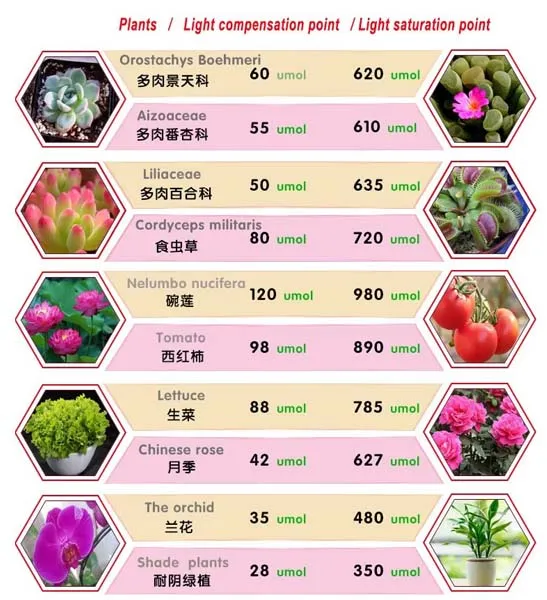
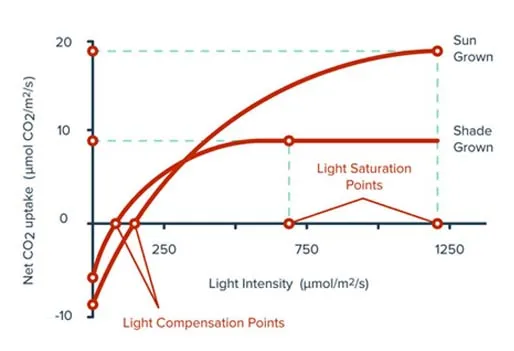
The cannabis light compensation point 63μmol/m²/s, light saturation point 1600 μmol/m²/s. No matter what kinds of light it is, the right amount of light is crucial for healthy plant growth.
Practical Tips:
- Know Your Plants: Research the specific light needs of your plant species at each stage of growth.
- Measure and Adjust: Use a light meter to measure the actual PPFD at the plant canopy level and adjust the height or output of your grow lights accordingly. Or follow the sellers instruction to set lights during different growth stages. (PS – the seller should have a good knowledge of plants and lights.)
- Avoid Overexposure: Be cautious not to exceed recommended PPFD ranges, as this can lead to heat stress, leaf damage, or reduced yields.
Additional Insights on PPFD and LED Grow Lights:
We frequently encounter inquiries from both customers and fellow manufacturers about PPFD.
A common question revolves around the practical expectations for PPFD values, where a target range of 900-1000 at the edge of the coverage area is generally sufficient for mrijuana growing, though higher values are always preferable. Achieving these levels becomes challenging, especially with larger grow lights, like 4x6ft 4x8ft growlights (i mean the product size is 4x6ft 4x7ft, not the coverage only) or those incorporating blue light, UV, and IR spectrums due to their expanded coverage areas.
Some customers have noted discrepancies when using personal light meters compared to factory tests conducted under controlled conditions with reflective surfaces, which can yield higher readings. This highlights the importance of considering testing environments and instrument accuracy when assessing PPFD.
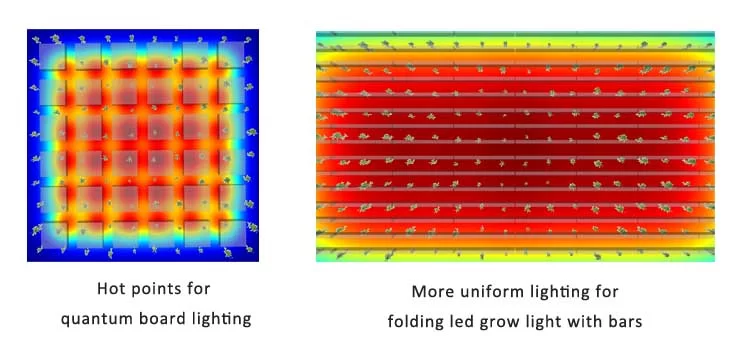
It’s crucial to understand that the efficacy of individual LEDs does not solely dictate the overall performance of the completed fixture. For example, the LM301H EVO leds, PPE 3.14 μmol/J individual, but the grow lamps built with 301h evo always come with lower PPE. The total number of LEDs, as well as the size of the fixture and the density of LED bars, significantly influence the final PPFD output. For instance, fixtures with fewer LEDs but a more concentrated layout, like a 4×4 foldable design, can also achieve high PPFD due to focused light distribution. Similarly, quantum board designs also excel by concentrating light over smaller areas.
While opting for white light with a high color temperature can boost PPFD figures, it’s essential for cultivators to balance this with other growth factors such as yield and flower quality. Incorporating blue light, UV, and IR enhances these aspects, leading to superior crop quality and market value, despite potentially lower PPFD readings.
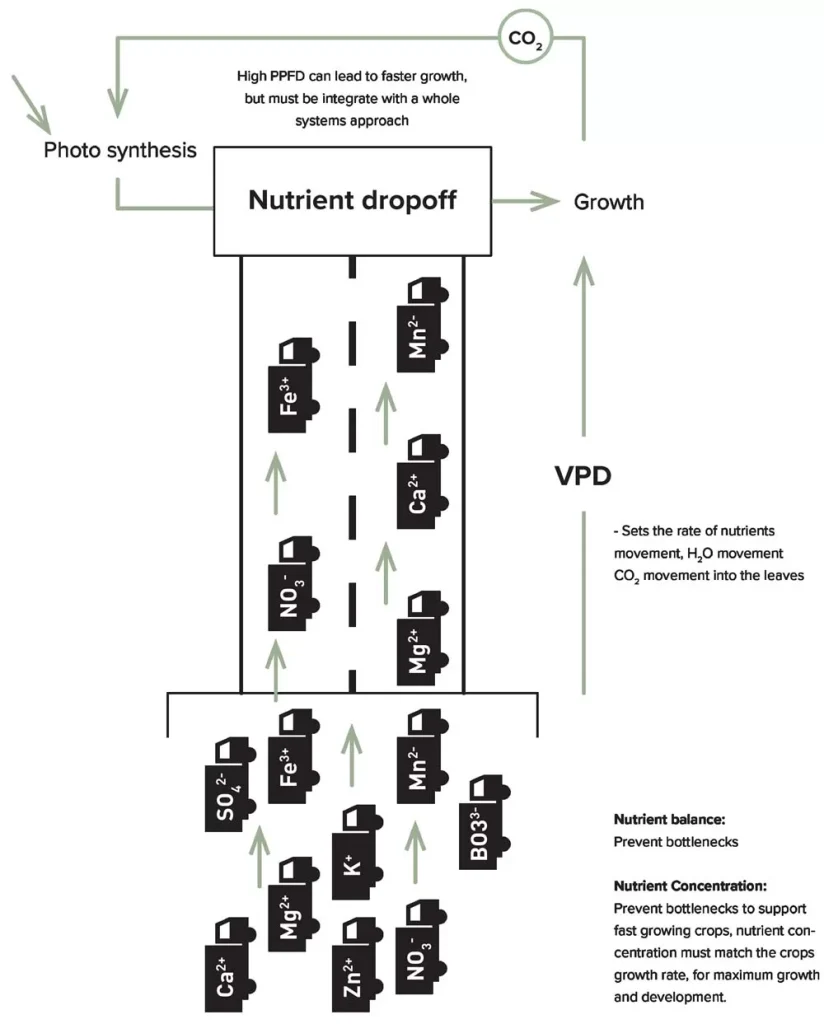
While striving for high PPFD is important, it’s equally vital to consider the comprehensive needs of plant growth, including spectral composition tailored to specific crops and growth stages. Balancing PPFD with other lighting parameters ensures optimal cultivation outcomes.
Understanding Light Metrics: PPFD, PAR, Lumen, PPE and PPF in Grow Lighting
PPFD (Photosynthetic Photon Flux Density):
PPFD represents the number of photosynthetically active photons that strike a specific area per second. It’s a fundamental metric in horticulture as it directly correlates with the light energy available for plants to carry out photosynthesis, which is crucial for their growth and development.
PAR (Photosynthetically Active Radiation):
PAR refers to the portion of the electromagnetic spectrum (typically between 400-700 nanometers) that plants utilize for photosynthesis. It’s different metric to PPFD. While PAR is an important concept, its measurement isn’t always as precise or standardized as PPFD when it comes to quantifying light effectiveness for plants. Manufacturers may provide PAR values, but they are generally considered less definitive indicators for plant growth compared to PPFD.
Lumens:
Lumens are a measure of the total amount of visible light emitted by a source, regardless of whether it’s beneficial for plant growth. Unlike PPFD, which focuses specifically on photosynthetically active radiation, lumens encompass all types of visible light. In the context of grow lighting, lumens aren’t typically a primary concern since they don’t differentiate between useful and non-useful wavelengths for plants. Instead, lumens are more relevant in general indoor and commercial lighting applications where human visual perception is the priority.
PPE (Photonic Efficacy):
PPE measures the efficiency with which a light source converts electrical power into photosynthetically active photons. Higher PPE means more photons are produced per watt of electricity consumed, making the light source more energy-efficient. However, pursuing the highest PPE doesn’t always translate into better plant growth outcomes. It’s only for energy saving. If a grow light meets the necessary PPFD requirements within a desired power consumption and price range, it might not be necessary to prioritize PPE above overall effectiveness and cost-effectiveness. (PS – this article explained grow lights cost, and leds >> Unveiling the Price Variances in Led Grow Lights – What’s the Best Led Grow Lights)
PPF (Photonic Power Factor):
PPF is calculated as PPE multiplied by the power of the light source(PPF = PPE * Wattage). It provides a combined view of how much photosynthetically active light output is generated relative to the input power. While PPF gives an idea about the total photonic output, it’s not as valuable a metric as PPFD for growers because it doesn’t account for the spatial distribution or quality of light that plants actually use for growth.
In summary, while lumen counts play a significant role in designing lighting for human environments, PPFD reigns supreme in the realm of plant cultivation. By understanding these distinctions, growers can better select lighting systems that cater to the unique needs of their crops, optimizing both efficiency and productivity.
Quantum Board Grow Lights: Pros and Cons for Different Cultivation Scales
Power Considerations:
In the market, quantum board grow lights are known for their low price compared to foldable led grow light. You may not find that the quantum board grow lights’ actual power also very low. For instance, a light advertised as 1000W or 2000W may only deliver between 100W to 280W of real power. This characteristic makes them suitable for home cultivation or small-scale hobbyist growers who benefit from concentrated light, high PPFD levels, and affordability. However, these advantages come at the cost of reduced scalability for larger operations.
Limitations for Large-Scale and Commercial Growing:
For commercial growers and those managing large-scale cultivation, quantum boards fall short due to their size, limited power output, and higher installation and maintenance costs per unit area. The need for numerous units to cover expansive growing spaces can escalate expenses and complexity in management.
Foldable Grow Lights: A Preferred Choice for Large Operations:
Conversely, foldable grow lights have gained popularity among large-scale and commercial growers for several reasons:
- High Power and Efficiency: They offer robust power outputs and excellent light efficacy, ensuring ample illumination even over vast areas.
- Customization and Cost-Effectiveness: These lights can be tailored to specific needs, providing a balance between performance and cost that is hard to beat.
- Ease of Installation and Maintenance: With simpler setup processes and lower ongoing maintenance requirements, they save on labor costs—a significant advantage in regions where labor is expensive.
- Wide Coverage Area: Their design allows for broad coverage, making them ideal for large grows where uniform lighting is crucial.
In summary, while quantum board grow lights excel in compact settings and for enthusiasts seeking cost-effective solutions with high PPFD, they are less suited for the demands of commercial-scale operations. Foldable grow lights, with their combination of power, efficiency, customization options, and ease of use, emerge as the preferred choice for large-scale cultivators aiming to optimize yields and manage operational costs effectively.
Price Reasonableness of LED Grow Lights: Balancing Cost and Cultivation Outcomes
When discussing the price reasonableness and cost-effective of LED grow lights, you can check our previous articles:Unveiling the Price Variances in Led Grow Lights – What’s the Best Led Grow Lights.
And end-users are most concerned with yield and quality. For instance, growers cultivating marijuana focus on factors like yield, color vibrancy, and THC content. These elements directly impact the market value and consumer satisfaction of their produce.
Therefore, when choosing LED grow lights, one should not solely rely on price or PPFD values to determine their efficacy. A high PPFD value doesn’t necessarily guarantee optimal growth results since plant development is influenced by various factors including spectral distribution, light uniformity, and heat dissipation of the fixture.
If there are 2 choices:
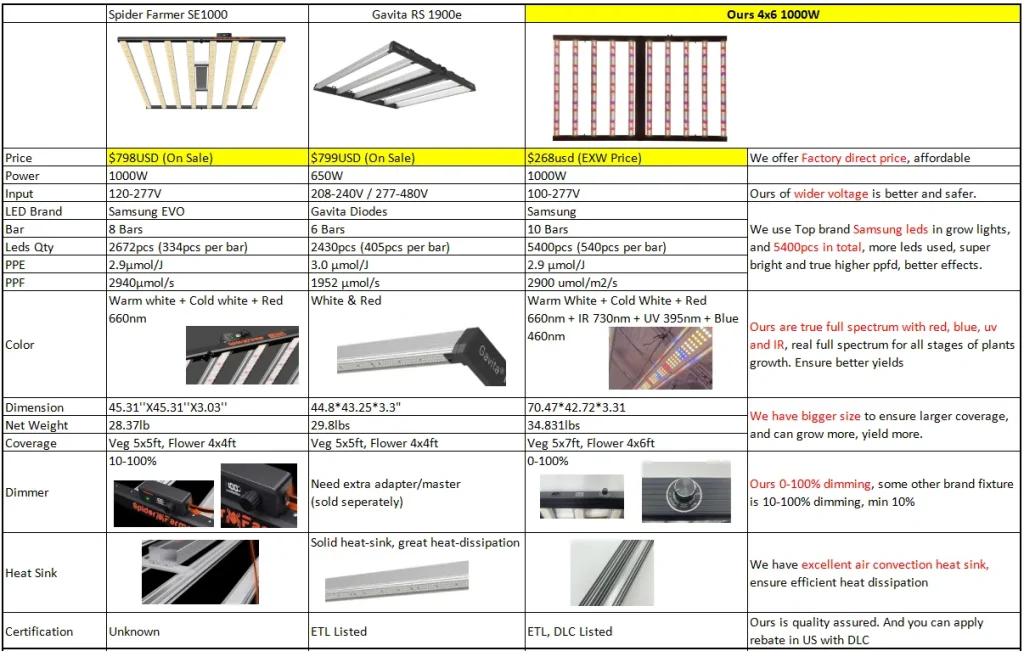
- A light 4x4ft 1000w with LM301H EVO prices $899usd, It’s of PPE2.9μmol/J, spectrum with white and red leds only, 2672pcs leds in total.
- A light 4x6ft 1000w with LM281B price $428usd. It’s of PPE2.9μmol/J, spectrum with white, red, blue, uv, ir leds, 5400pcs leds in total.
There is no doubt that the second one has the best cost-effectiveness, and the effect of planting is definitely better than the first one. Because:
- The price is only half
- Although the lamp beads used are LM281B, which is slightly worse than the first LM301H EVO, the PPE is the same 2.9μmol/J, because it has enough lamp beads.
- A full spectrum that is truly suitable for marijuana plant growth, including red light, blue light, UV, IR
- The lamp size is large and the irradiation area is larger. A 4x6ft lamp can irradiate a maximum of 6x8ft, which means that under the same planting area, we can use fewer lamps and lower investment
- The light is uniform. Of course the PPFD will be lower than the first onem for larger space. But PPFD is enough to meet the needs of plant growth, and too much is not good for growth. (PS- See light compensation point and light saturation point for details)
- The power is the same
Based on this situation, it is definitely the second one to choose.
-
Full Spectrum Light: It promotes overall plant growth by providing a balanced mix of wavelengths similar to natural sunlight. This light is beneficial for root, stem, leaf, flower, and fruit development, making it suitable for a wide variety of plants.
-
Red Light: It is essential for promoting flowering and fruiting. It influences photoperiodism and can enhance chlorophyll production, which is vital for photosynthesis.
-
Blue Light: Blue light is crucial for vegetative growth, such as leaf and stem development. It also plays a significant role in enhancing photosynthesis and influencing the opening of stomata.
-
Ultraviolet (UV) Light: UV light has a dual role; while it can be harmful in excessive amounts, small doses can stimulate the synthesis of compounds like anthocyanins and flavonoids, which contribute to plant health and stress resistance.
-
Infrared (IR) Light: Infrared light, particularly far-red light, affects plant hormones that control growth and development. It can influence processes such as seed germination, flowering time, and senescence.
Other Common Points
Spectrum Adjustable
Different plants and their various growth stages indeed require different types of light. In a previous section, we briefly introduced the role each spectrum plays in plant growth. Many grow lights on the market offer spectrum adjustability. This means that you can set different spectrum at different growth stages of the plant, targeting its development more precisely to increase yield and quality. This feature is relatively advanced and professional. We also offer such lights, including dual-channel and tri-channel options. If you’re not very familiar with these technical aspects and find them challenging to operate, I would recommend sticking with standard full-spectrum lights. These are easy to use and suitable for all stages of plant growth.
Led Grow Light 4x4Ft, 5x5Ft, 6x6Ft, 4x6Ft, 4x8Ft
You may see many product links stated with 4x4ft 5x5ft 6x6ft 4x6ft and 4x8ft. Usually 4x4ft 4x6ft 4x8ft refers to the actual size of the product. 5x5ft 6x6ft refers to coverage area of the product. It is better to ask the seller whether the size refers to the product size or the coverage. As for Maksdep grow lights, all stated 4x4ft 4x6ft x48ft and 4x10ft are the products dimension. 4x10ft is very big, length of 10ft, 3m.
Waterproof IP65
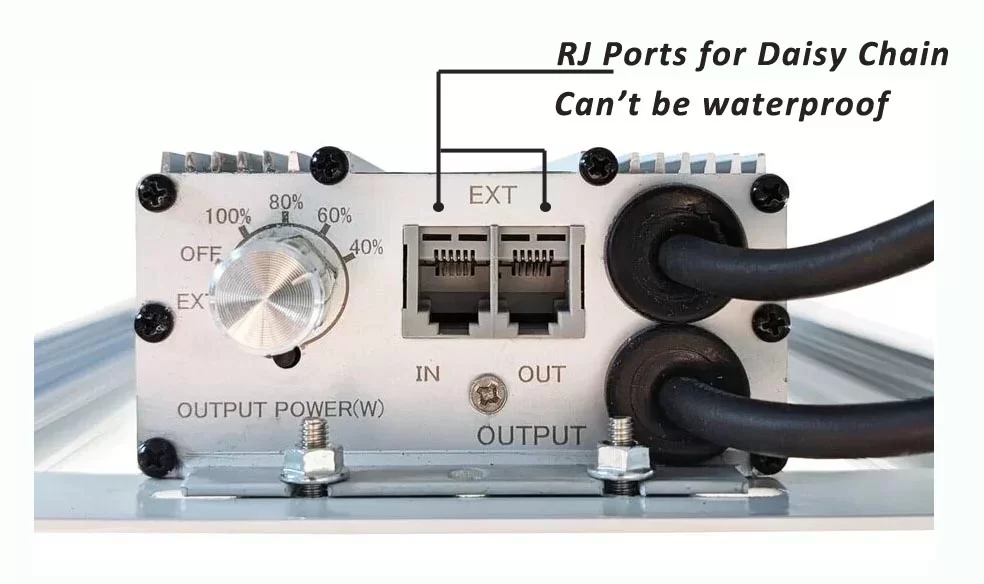
We often encounter customers asking if our lights have IP65 even IP66 ratings. In fact, for indoor cultivation, most grow lights are not fully waterproof and typically have an IP54 rating, which protects against dust ingress and light splashing of water. This level of protection is sufficient for basic spray applications. The reason they are not fully waterproof lies in their design: the building with RJ ports used for controller connections cannot be made waterproof. If a seller claims their lights are waterproof with an IP65 or IP66 rating, they are likely misleading you. Additionally, in practical use cases, there’s no need for such high levels of waterproofing. The lights are usually mounted at the top and are not immersed in water. An IP65 rating indicates that the light can be directly submerged in water, which is unnecessary for typical growing environments.
Warranty
A warranty is indeed important. The standard warranty period for most products on the market ranges from 2 to 3 years, while some offer up to 5 years. Products with a 5-year warranty are generally priced higher due to the use of better components and additional after-sales costs.
However, many buyers overlook an essential aspect: even if a product claims a 5-year warranty, whether the seller will respond promptly and effectively in the event of a claim remains uncertain. This is because some companies may go out of business within five years or fail to honor their promises. Therefore, choosing a reliable supplier is crucial. You can assess their reliability by checking how long they have been in operation—a company that has been in the industry for ten years and is still going strong is likely trustworthy. Additionally, having comprehensive certifications is important. Especially critical is having local after-sales service available overseas. We, MAKSDEP, have 16 years of manufacturing experience and hold various certifications ETL, DLC, CE, RoHS, UKCA, ISO9001 etc. We also have local after-sales service centers in countries such as the USA, Germany, and Thailand. If you need assistance, please feel free to contact us. Click to have a consultation.
That concludes today’s sharing. If you wish to learn more about plant lights or the horticulture industry, feel free to bookmark our website. We also welcome your comments and discussions. Additionally, if you are in need of plant grow lights, please consider reaching out to us for a collaboration or purchase.
