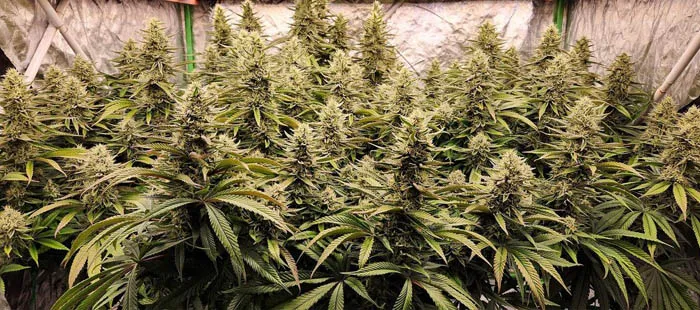

In the world of plant cultivation, light is the driving force behind growth and vitality. One crucial aspect of light management is understanding the concept of Daily Light Integral (DLI). DLI measures the total amount of photosynthetically active radiation, which is received by plants in a day, playing a pivotal role in determining their health and productivity. In this article, we will use a question-and-answer format to get a comprehensive and detailed understanding of DLI.
Do you know DLI?
Yed, DLI stands for “Daily Light Integral.” It is a measure used in horticulture to quantify the total amount of photosynthetically active radiation (PAR) received by a plant over the course of a day. DLI is typically expressed in units of moles of photons per square meter per day (mol/m²/day) and represents the cumulative amount of light available for photosynthesis.
DLI is an important metric for growers as it helps determine the amount of light a plant receives and consequently influences its growth, development, and overall productivity. By monitoring DLI levels, growers can optimize lighting conditions in indoor or greenhouse settings to meet the specific needs of their plants and maximize yield potential.
Do you know PPFD?
Yes, PPFD stands for “Photosynthetic Photon Flux Density.” It is a measure used in horticulture and lighting design to quantify the amount of photosynthetically active radiation (PAR) that falls on a given surface area per unit of time. PPFD is typically expressed in units of micromoles of photons per square meter per second (µmol/m²/s).
PPFD measures the intensity of light that is available for photosynthesis and directly influences plant growth, development, and yield. It provides valuable information about the amount of light reaching the plant canopy, helping growers optimize lighting setups for indoor cultivation or greenhouse environments. By adjusting PPFD levels, growers can ensure that plants receive adequate light for optimal photosynthesis and overall health.
It seems they both are related light for plant growth, then what’s the differences and relationships between them?
DLI, or Daily Light Integral, and PPFD, or Photosynthetic Photon Flux Density, are both metrics used in horticulture to quantify light intensity for plant growth, but they measure different aspects of light.
DLI (Daily Light Integral):
- DLI measures the total amount of photosynthetically active radiation (PAR) received by plants over the course of a day, expressed as the number of moles of photons per square meter per day (mol/m²/day).
- It represents the cumulative amount of light available for photosynthesis during a 24-hour period and takes into account both the intensity and duration of light exposure.
- DLI is a useful metric for understanding how much light energy plants receive over time and is important for determining light requirements for different crops and growth stages.
PPFD (Photosynthetic Photon Flux Density):
- PPFD measures the instantaneous light intensity at a specific point in time, expressed as the number of photons (photons) per unit area per unit time (µmol/m²/s).
- It represents the intensity of light available to plants at a given moment and provides information about the immediate light conditions in a particular area of the growing environment.
- PPFD is valuable for assessing light distribution within a growing space, optimizing lighting setups, and ensuring that plants receive sufficient light for photosynthesis during each growth stage.
Relationship between DLI and PPFD:
- DLI and PPFD are related in that DLI is the cumulative result of PPFD measurements over time. In other words, DLI is calculated by integrating PPFD measurements taken at regular intervals throughout the day.
- To determine DLI, you would measure PPFD at multiple points in the growing area over the course of a day and sum up the PPFD values to get the total light received by plants during that period.
- PPFD provides instantaneous information about light intensity, while DLI gives an overall measure of light quantity accumulated over time.
- Growers use both DLI and PPFD measurements to ensure that plants receive adequate light for healthy growth and to optimize lighting strategies for indoor cultivation or greenhouse production.
Does different plants needs different DLI?
Yes, different plants have varying requirements for DLI (Daily Light Integral) based on their species, growth stage, and environmental conditions. The ideal DLI for a specific plant depends on factors such as its natural habitat, photosynthetic efficiency, and light requirements during different growth phases.
- Plant Species: Different plant species have evolved in diverse environments with varying light intensities. For example, plants native to tropical regions, such as certain fruits and vegetables, may require higher DLIs due to their adaptation to intense sunlight, while shade-tolerant plants may thrive with lower DLIs.
- Growth Stage: The DLI requirement of a plant can vary throughout its growth stages. For instance, seedlings and young plants typically require lower DLIs to avoid light stress, while mature plants often benefit from higher DLIs to support flowering, fruiting, and overall growth.
- Environmental Conditions: Factors like temperature, humidity, and CO2 levels can influence a plant’s photosynthetic activity and DLI requirement. Plants grown in controlled environments, such as indoor farms or greenhouses, may have their DLIs adjusted to optimize growth and yield.
- Crop Specifics: Certain crops, such as leafy greens or herbs, may have specific DLI recommendations tailored to their cultivation practices and desired attributes, such as flavor, texture, or appearance.
Therefore, growers need to consider the specific DLI requirements of the plants they are cultivating and adjust their lighting strategies accordingly. Monitoring DLI levels and providing the appropriate light intensity and duration can help optimize photosynthesis, growth, and overall plant health.
Can you give some data about DLI to different plants?
High-light Plants (DLI > 25 mol/m²/day):
- Tomatoes: 25 – 35 mol/m²/day
- Peppers: 25 – 35 mol/m²/day
- Cucumbers: 25 – 35 mol/m²/day
- Cannabis (vegetative stage): 25 – 40 mol/m²/day
- Roses: 25 – 35 mol/m²/day
Medium-light Plants (DLI 15 – 25 mol/m²/day):
- Lettuce: 15 – 20 mol/m²/day
- Herbs (e.g., basil, parsley): 15 – 20 mol/m²/day
- Kale: 15 – 20 mol/m²/day
- Spinach: 15 – 20 mol/m²/day
- Swiss chard: 15 – 20 mol/m²/day
Low-light Plants (DLI < 15 mol/m²/day):
- Microgreens: 10 – 15 mol/m²/day
- Succulents: 5 – 10 mol/m²/day
- Ferns: 5 – 10 mol/m²/day
- Mosses: 5 – 10 mol/m²/day
Different plants DLI and PPFD recommendation:


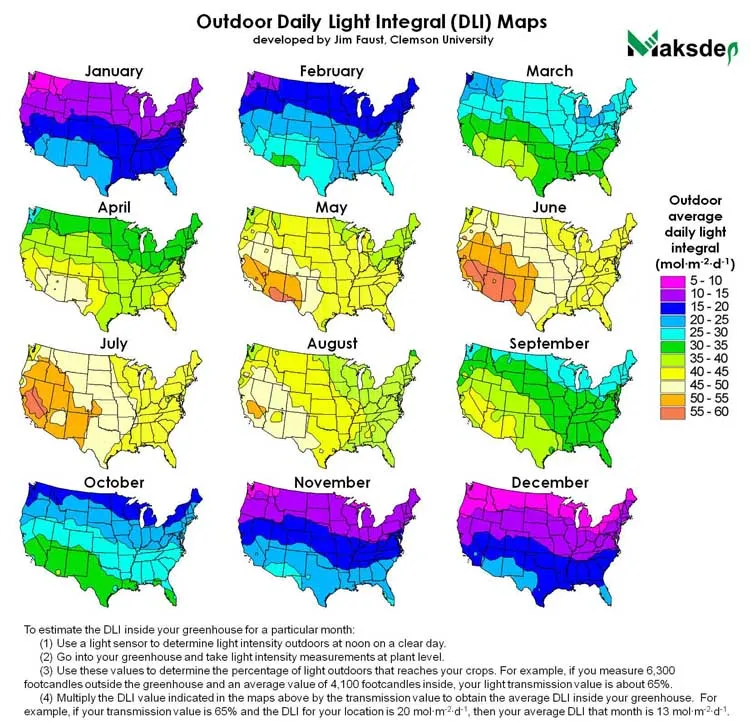
Different locations may experience different DLI, right?
Yes. Different locations experience varying levels of natural sunlight due to factors such as latitude, altitude, weather patterns, and seasonal changes. As a result, the Daily Light Integral (DLI) can vary significantly depending on the geographic location.
For instance, regions closer to the equator generally receive more direct sunlight throughout the year, leading to higher DLIs compared to areas farther away from the equator. Similarly, regions at higher altitudes may experience increased light intensity due to reduced atmospheric interference, resulting in higher DLIs.
It’s essential for growers to consider the specific DLI of their location when planning and managing indoor or outdoor cultivation operations. By understanding the local light conditions, growers can optimize lighting strategies to ensure that plants receive adequate light for healthy growth and development.

I use led grow lights, is it still important to concern DLI?
I use led grow lights, is it still important to concern DLI?
Yes, even when using LED grow lights for indoor cultivation, the Daily Light Integral (DLI) remains an important factor to consider for optimizing plant growth and development. LED grow lights are designed to emit specific wavelengths of light that are essential for photosynthesis, but the intensity and duration of light exposure still play a crucial role in plant health.
DLI indicates the total amount of photosynthetically active radiation (PAR) received by plants over the course of a day. It helps growers understand whether plants are receiving sufficient light for optimal growth, flowering, and fruiting.
A sufficient DLI is essential for optimal photosynthesis, as it provides the energy necessary for plants to convert carbon dioxide and water into glucose and oxygen. Higher DLI levels typically result in increased rates of photosynthesis, leading to faster growth rates, greater biomass production, and improved overall plant health.
Conversely, inadequate DLI can limit photosynthetic activity and stunt plant growth. Plants grown in environments with insufficient light may exhibit symptoms such as elongated stems, pale or yellowing leaves, reduced flowering or fruiting, and overall poor vigor.
While LED grow lights can provide precise control over light spectrum and intensity, ensuring that plants receive an adequate DLI is essential for promoting healthy growth and maximizing yields. Growers can adjust the light intensity, duration, and spectral output of LED grow lights to achieve the desired DLI for different stages of plant growth.
By monitoring and managing DLI levels, growers can fine-tune their indoor lighting strategies to mimic natural sunlight and provide plants with the optimal light conditions for robust growth and development.
So by using led grow light, growers can control the DLI and let plant have enough and desired lighting experiences, then grow better harvest better?
Exactly! LED grow lights offer growers precise control over the light spectrum, intensity, and duration, allowing them to tailor the lighting environment to meet the specific needs of their plants. By manipulating these factors, growers can effectively manage the Daily Light Integral (DLI) and ensure that plants receive the optimal amount of light for healthy growth and development.
Controlling the DLI with LED grow lights enables growers to mimic natural sunlight conditions and provide consistent and uniform lighting experiences for their plants throughout the growth cycle. This optimization of light exposure can lead to improved photosynthesis, enhanced nutrient uptake, increased biomass production, and ultimately better harvest yields.
Furthermore, LED grow lights are energy-efficient and emit less heat compared to traditional lighting sources, making them ideal for indoor cultivation where temperature control is crucial. With the ability to adjust DLI using LED grow lights, growers can create an optimal growing environment that maximizes plant growth potential and ensures higher-quality yields.
How to calculate DLI?
The Daily Light Integral (DLI) can be calculated by integrating the photosynthetic photon flux density (PPFD) measurements over the course of a day. Here’s how you can calculate DLI:
- Measure PPFD: Measure the PPFD at various points throughout the day using a quantum sensor or a light meter. PPFD is typically measured in micromoles per square meter per second (μmol/m²/s).
- Calculate the Total PPFD: Sum up all the PPFD measurements taken at different times during the day to find the total amount of photosynthetic photons received by the plants over the entire day.
- Convert Units (Optional): If necessary, convert the total PPFD from micromoles per square meter per second (μmol/m²/s) to moles per square meter per day (mol/m²/d) by multiplying by the number of seconds in a day (86,400 seconds).
- Interpret DLI: The resulting value represents the DLI, which is expressed in moles per square meter per day (mol/m²/d). This value indicates the total amount of photosynthetically active radiation received by the plants over a 24-hour period.
By calculating DLI, growers can assess whether their plants are receiving sufficient light for optimal growth and adjust their lighting strategies accordingly to meet the desired DLI levels.

I am growing marijuana, can you give me some advices?
Certainly! Here’s the advice on DLI and LED grow lights for indoor marijuana cultivation:
- Understand Marijuana Requirements: Marijuana is a high-level DLI needed plants, vegetative states, it needs 25-40 mol/m²/day, during flowering stages, it will needs higher. So powerful high lighting intensisty is required.
- Choose the Right Spectrum: LED grow lights offer different spectra, including blue, red, and white lights. Each spectrum influences different growth stages and specific plant characteristics. For instance, blue light aids in vegetative growth, while red light promotes flower formation and fruiting. Usually we use full spectrum led grow light with red blue ir, it’s ideal choive for indoor cannabis growing.
- Consider Light Coverage: Ensure that the LED light’s coverage extends to all plants in your cultivation area to guarantee uniform light distribution.
- Check for Light Uniformity: Some LED lights may produce uneven light distribution, hot point in center, like quantum board. Bar style lights can delivery very uniform lighting. Opt for LED grow light bar with excellent light distribution and uniformity to ensure consistent lighting throughout the growing area.
- Factor in Energy Efficiency and Durability: LED lights are typically more energy-efficient and durable compared to traditional high-pressure sodium or metal halide lights. Choosing LED grow lights with high energy efficiency and long lifespan can reduce energy consumption and maintenance costs, thereby enhancing cultivation efficiency.
- Lastly, carefully research product specifications and user reviews when selecting LED lights to ensure you choose high-quality LED grow lights that suit your cultivation needs.
We are led grow light supplier, providing 8000+ lights per month. We are professional can offer you the most suitable lights for your project.
Thanks for view this article, where we hope to provide you with valuable insights to enhance your cultivation journey. Should you have any further questions or require assistance, please, feel free to reach out to us. Our team is here to provide you with expert guidance and support.