
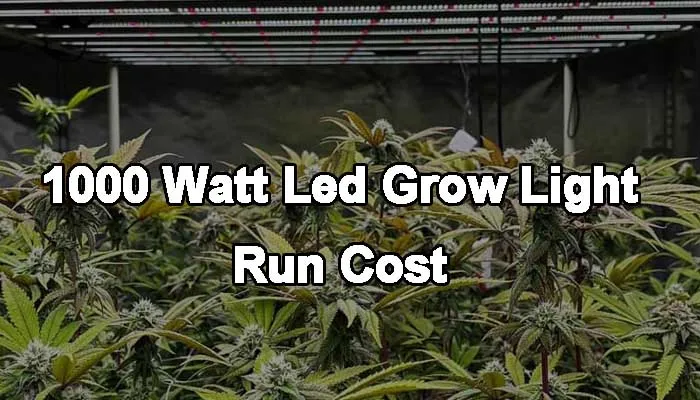
When setting up a grow room, understanding the electricity consumption of your equipment is crucial. Proper planning will help you avoid being shocked by a hefty monthly energy bill. Calculating the electricity usage of an LED grow light involves three key factors:
- The wattage of the LED grow light.
- The daily operating time of the light.
- The electricity rate in your area.
This article will break down how to calculate the electricity cost of a 1000w grow lamp and address common questions like “How much does it cost to run a grow light?” and “Do LED grow lights use a lot of electricity?”
1. Choosing the Right 1000-Watt Grow Light
A 1000 watt grow light is a popular choice for growers looking to provide sufficient light for their plants. However, there are several types of 1000 watt grow lights to consider, including:
- 1000 watt LED lights
- 1000w grow lamps (such as HID or HPS)
The type of light you choose will impact not only plant growth but also your electricity costs. LED lights, for example, are far more energy-efficient compared to traditional 1000 watt bulbs like HID or HPS. While a 1000w LED light provides the same level of brightness, it uses less power and generates less heat, making it a better long-term investment.
Customizing Your Light Setup
If you’re using a 1000 watt grow light kit, you may have the option to adjust light intensity for different growth stages. For example:
- Seedling stage: Lower intensity to prevent burning.
- Vegetative stage: Increase light output for optimal growth.
- Flowering stage: Use full intensity for maximum yield.
Keep in mind that too much light can harm your plants, especially if you’re using 1000 watt UV lights or other high-intensity bulbs. Always match the light intensity to your plants’ needs.
2. How Long Should LED Grow Lights Run Each Day?
The daily operating time of your LED grow light depends on the type of plants you are cultivating. Different crops require different amounts of light:
-
Cannabis:
- Growth stage: 18 hours of light per day.
- Flowering stage: 12 hours of light per day.
-
Leafy greens (e.g., lettuce):
- Typically require 14 hours of light per day.
Tips for Efficient Light Usage
If your grow room has a glass roof or transparent walls, your plants can take advantage of natural sunlight during the day. In this case, your grow lights only need to run during the morning and evening. This setup can significantly reduce grow light electricity cost.
Light Balance Matters
Plants respond directly to light intensity and duration. Insufficient light will weaken plants, while excessive light can burn them. Adjust your lighting schedule based on your plants’ reactions and growth stage.
3. Understanding Local Electricity Rates
Electricity costs vary depending on your location and whether you use residential or commercial electricity rates. Before setting up your grow room, investigating local electricity prices can save you significant money in the long run.
Residential vs. Commercial Electricity Rates
-
New Jersey:
- Residential rate: 17 ¢/kWh.
- Commercial rate: 14.2 ¢/kWh.
-
Australia:
- Residential rate: 22.1 c/kWh.
- Commercial rate: 18.5 c/kWh.
Typically, commercial electricity rates are slightly cheaper than residential rates, making them more cost-effective for larger greenhouse projects.
4. How Much Does a 1000-Watt LED Grow Light Cost to Run?
To calculate the monthly cost of running a 1000 watt LED grow light, you’ll need to consider three factors:
- Wattage of the grow light (e.g., 1000 watts).
- Daily operating hours.
- Electricity rate in your area.
Once you know the wattage, operating time, and electricity rate, calculating the monthly electricity cost becomes straightforward. Use the following formula:
Monthly Electricity Cost (USD) = Power Consumption (kWh) × Operating Hours × Electricity Rate (USD/kWh)
Example Calculation: Residential Grow Room
Let’s say you’re running a 1000 watt LED grow light for 12 hours per day, and your local electricity rate is 17¢ per kWh. Here’s how to calculate the cost:
-
Convert wattage to kilowatts:
1000 watts ÷ 1000 = 1 kWh. -
Calculate monthly operating hours:
12 hours/day × 30 days = 360 hours/month. -
Determine electricity cost per month:
1 kWh × 360 hours × $0.17/kWh = $61.20 per month.
Example Calculation: Large Greenhouse
Now, let’s consider a larger setup with 20 1000 watts grow lights, each running for 6 hours per day. Using Australia’s commercial electricity rate of 18.5¢ per kWh, the monthly cost would be:
-
Total wattage:
20 lights × 1000 watts = 20,000 watts = 20 kWh. -
Monthly operating hours:
6 hours/day × 30 days = 180 hours/month. -
Electricity cost per month:
20 kWh × 180 hours × $0.185/kWh = $666.00 per month.
These calculations show how your grow light electricity cost can vary depending on the size of your operation and your electricity rate.
5. Do Grow Lights Use a Lot of Electricity?
This is one of the most frequently asked questions by growers: “Do plant lights use a lot of electricity?” The answer depends on several factors:
-
Yes, grow lights can use a lot of electricity if you operate them continuously or have multiple high-wattage lights in your setup. For example, running several 1000 watt LED grow lights for 12–18 hours daily will result in a significant monthly electricity bill.
-
No, modern LED grow lights are energy-efficient compared to older technologies like HID or HPS. A 1000w LED light can provide the same light intensity as a 1000 watt HID bulb while consuming less electricity and generating less heat.
How Much Energy Do Grow Lights Use?
The energy consumption of grow lights depends on their wattage and daily usage. A single 1000 watt LED grow light used for 12 hours a day will consume:
- 1 kWh per hour × 12 hours = 12 kWh per day.
- Over a month: 12 kWh/day × 30 days = 360 kWh.
Multiply this by your local electricity rate to estimate your monthly costs.
Why Choose LED Grow Lights?
- Energy Efficiency: LED lights convert more electricity into usable light and less into heat, reducing waste.
- Versatility: Adjustable light intensity allows you to cater to different growth stages.
- Long-Term Savings: Although the initial cost may be higher, their energy efficiency and durability make them a cost-effective choice over time.
6. Are 1000-Watt Grow Lights Worth It?
A 1000 watt LED grow light is an excellent choice for growers looking for high-intensity, energy-efficient lighting. While grow lights 1000 watt can lead to noticeable electricity costs, their efficiency and ability to produce higher yields make them a worthwhile investment.
By understanding how much electricity grow lights use and optimizing their operation, you can strike a balance between healthy plant growth and manageable electricity bills. Whether you’re using a 1000 watt LED grow light kit or a 1000w HPS light, careful planning will ensure you get the most out of your grow room while keeping costs under control.
FAQ: Common Questions About 1000-Watt Grow Lights
Here’s a comprehensive FAQ section covering additional questions customers might have about 1000-watt grow lights, their usage, and energy impact. This section aims to address concerns not already covered in the main article.
Yes, but you need to ensure that the grow tent is large enough to handle the light intensity. A 1000-watt LED grow light is ideal for larger grow spaces, typically around 20–35 square feet. In smaller setups, the light intensity might be too high, which can harm plants. Consider using dimmable LED grow lights to adjust the brightness for smaller spaces.
The distance depends on the type of light (LED, UV, HPS, etc.) and the plant’s growth stage:
- Seedling stage: 24–36 inches above the plants.
- Vegetative stage: 18–24 inches above the plants.
- Flowering stage: 12–18 inches above the plants.
LED grow lights, including 1000-watt LEDs, emit less heat than traditional lights, so they can usually be placed closer to plants. However, always monitor your plants for signs of light stress.
Yes, pairing 1000-watt grow lights with solar panels is a sustainable option. To determine the number of solar panels required:
- Calculate your grow light’s daily energy consumption (e.g., 12 kWh/day for a 1000-watt light running 12 hours/day).
- Check the output of your solar panels (e.g., a 300-watt panel generates ~1.2 kWh/day in sunny conditions).
- Divide the energy consumption by panel output to find the number of panels needed.
Solar panels can significantly reduce your electricity costs, especially for larger grow operations.
- Energy Efficiency: LEDs consume less electricity than HPS lights, making them more cost-effective.
- Heat Output: HPS lights generate more heat, requiring additional cooling systems, while LEDs produce minimal heat.
- Lifespan: LED lights last significantly longer (50,000+ hours) compared to HPS lights (~10,000–20,000 hours).
- Light Spectrum: LEDs offer a customizable spectrum, including UV and IR light, while HPS lights have a fixed spectrum.
The advertised wattage of an LED grow light (e.g., “1000-watt LED”) often refers to the theoretical maximum output. You may find some state 1000-watt LED light may only consume 100–200 watts. It’s because they state for attracting. If you go to buy grow lights, you should look carefully about it.
All our grow lamps are with actual wattage statement. If it state 1000w, then it actual draw 1000w. If 1600w, it’s 1600w. Welcome to check our products. >> Maksdep Grow Lights
Signs of excessive light exposure include:
- Leaves curling or turning yellow.
- Bleached or pale spots on foliage.
- Reduced growth or drooping leaves.
If you notice these symptoms, increase the distance between the light and plants or reduce the light intensity (if using a dimmable 1000-watt LED grow light).
To calculate ROI, consider:
- Initial Cost: The price of the grow light, including installation.
- Operating Costs: Monthly electricity costs (calculated using the energy consumption formula).
- Yield Increase: The additional revenue or savings generated by improved plant growth and yield.
For example, if a 1000-watt LED grow light costs $500 and increases your harvest value by $200 per month while costing $50/month to operate, the ROI is:
- ROI = (Monthly Profit ÷ Initial Cost) × 100
- ROI = (($200 – $50) ÷ $500) × 100 = 30% per month.
