Many believe that artificial lighting is only necessary in greenhouses that receive insufficient natural sunlight, and in regions with abundant sunlight, supplemental lighting isn’t needed. However, here’s an analysis that challenges this view.
Key Points:
- Sunlight Quality Isn’t Optimal for Photosynthesis: Although the sun is our primary light source, its spectral quality isn’t ideal for maximizing plant photosynthesis.
- Inconsistent and Insufficient Light Levels in Greenhouses: Even in sunny regions, the intensity of light inside greenhouses fluctuates and is generally inadequate.
- Low Photosynthetic Efficiency in Sun-Rich Regions: Despite abundant sunlight, greenhouses in such areas often experience low photosynthetic productivity.
- Quality and Consistency with Artificial Lighting: Without artificial lighting, it’s difficult to achieve a stable, high-quality, and continuous yield.
Quality of Sunlight forPlant Growth
The spectrum below shows the full-range wavelength distribution of standard AM1.5G sunlight.
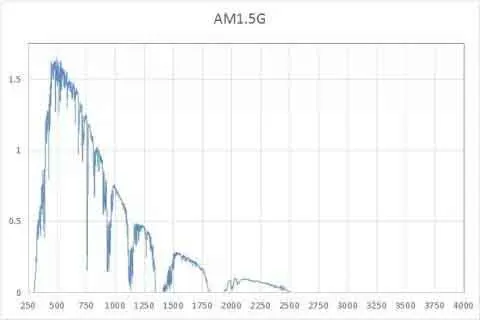
We can see, some wavelengths have absorption lines or bands due to the interaction of sunlight with Earth’s atmosphere, which absorbs or scatters certain wavelengths. This causes dips in the spectrum.
As shown, the standard sunlight spectrum ranges from 280 to 4000 nm.
The AM1.5G spectrum, commonly used in solar research, represents sunlight that passes through the atmosphere at an angle of 48.2 degrees.
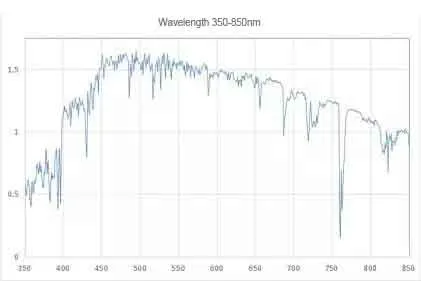
For plant lighting research, however, the wavelength range we focus on is 350-850 nm, with the following breakdown:
- Ultraviolet (350-399 nm): 9.34%
- Blue light (400-499 nm): 21.21%
- Green light (500-599 nm): 23.22%
- Red light (600-700 nm): 21.62%
- Far-red light (701-850 nm): 24.61%
- Red-to-blue ratio (R) = 1.02
The critical range for photosynthesis is 400-700 nm, known as the Photosynthetically Active Radiation (PAR) range. The spectrum below shows the distribution of AM1.5G within this PAR range:
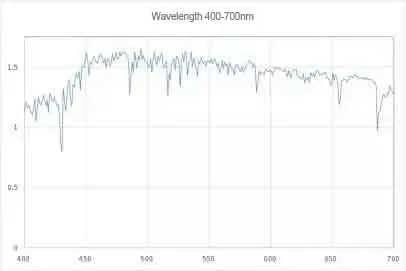
- Blue light (400-499 nm): 32.33%
- Green light (500-599 nm): 35.40%
- Red light (600-700 nm): 32.27%
- Red-to-blue ratio (R) = 1.02
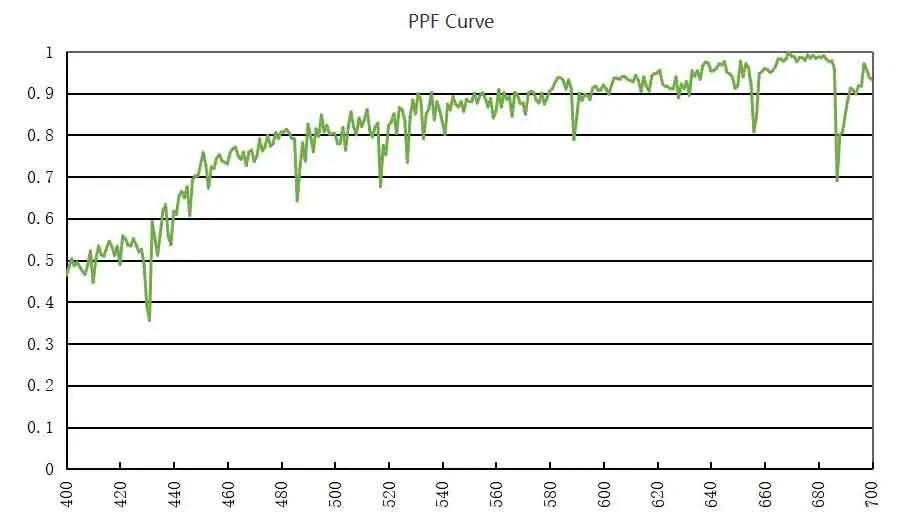
As data suggests, plants grow faster and photosynthesize more efficiently under artificial lighting than sunlight. Though sunlight is abundant, it doesn’t necessarily meet plants’ ideal light quality. Following the principle of “light quantity over quality,” supplemental lighting becomes essential to maintain consistent growth conditions.
So, what is the quality of sunlight on the ground in reality?
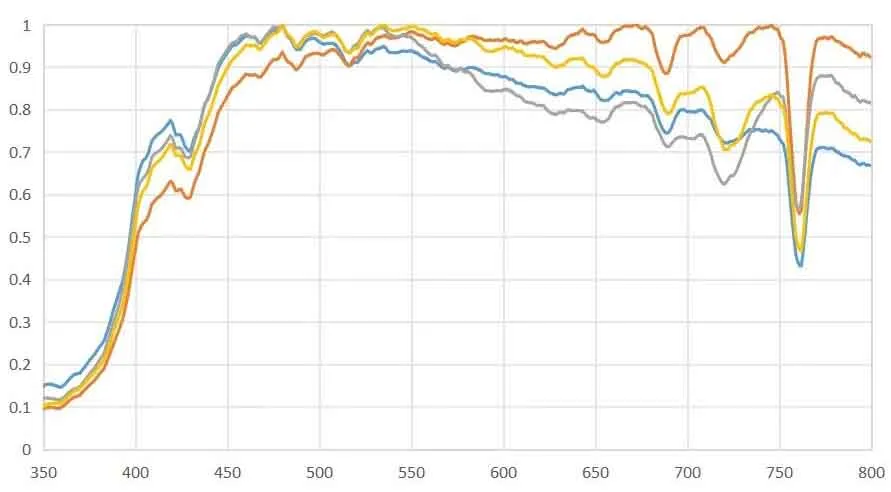
The sunlight quality varies across different regions: for instance, at latitudes 23° N (blue), 39° N (yellow), and 44° N (gray).
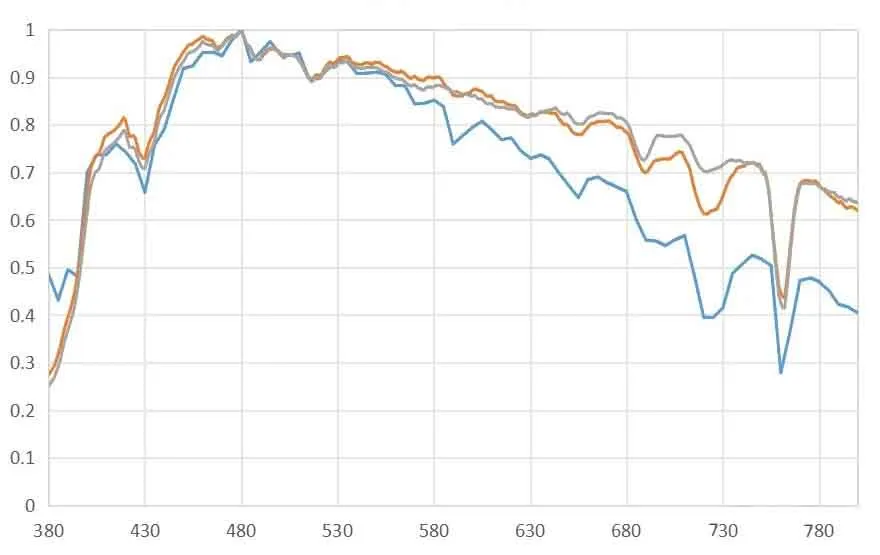
The chart above shows a normalized spectrum, indicating that the higher the latitude, the greater the proportion of blue light. However, this chart only illustrates the trend and does not reflect the red-to-blue ratio directly. We are focused on sunlight data inside greenhouses, which we’ll discuss in detail below.
Sunlight Quality In Greenhouses
Greenhouses, regardless of type, experience reduced sunlight due to factors like structural elements and covering materials (e.g., film or glass), which also affect the light spectrum.
The following graph shows spectral changes between the inside (yellow) and outside (blue) of a greenhouse.
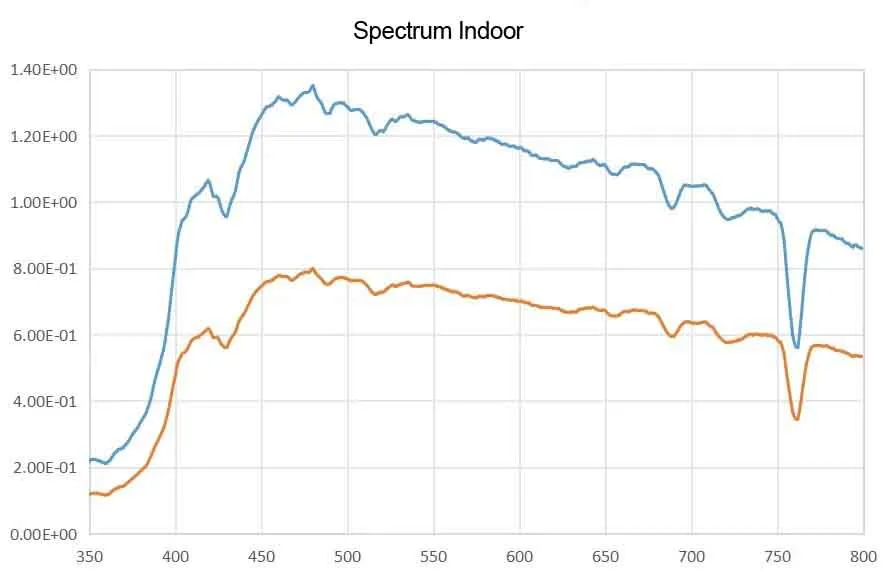
Calculations indicate that the reduction in light intensity inside greenhouses can reach more than 35%, even in advanced Venlo-style greenhouses, where the reduction is still greater than 28%. The greenhouse’s light-transmitting materials primarily reduce the intensity of ultraviolet and blue light.
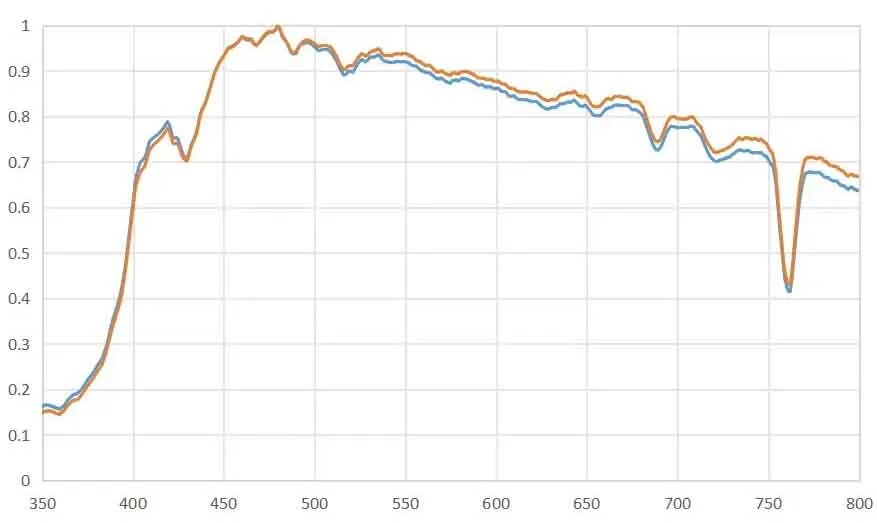
Materials like UV-filtering films or glass reduce UV and blue light, increasing the red-to-blue ratio. This adjustment is visually evident in the quantum light distribution graph below.
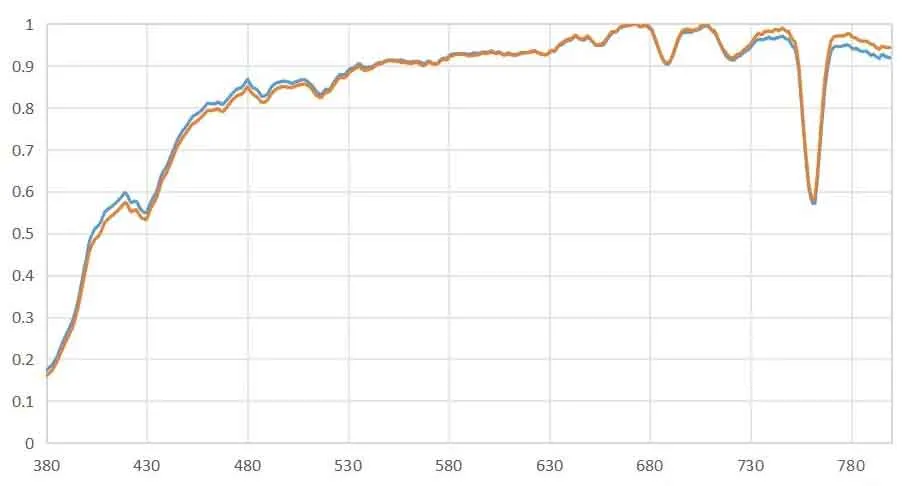
Based on calculations comparing the relative spectra inside and outside the greenhouse, a portion of the sunlight’s ultraviolet and blue light is absorbed, which leads to an increase in the red-to-blue ratio within the greenhouse.
The light quantum distribution chart below shows these changes in light quality more clearly.
The light quality inside the greenhouse also changes with different seasons, as shown below.
Numerous factors affect sunlight quality inside greenhouses, including seasonal changes, weather, and dust accumulation on materials. Consequently, without supplemental lighting, natural light conditions inside greenhouses are variable and difficult to control, directly impacting plant quality and yield.
Sunlight Quantity Inside Greenhouses
A useful metric for measuring sunlight exposure is the Daily Light Integral (DLI),
DLI, represents the cumulative amount of sunlight per square meter per day, measured in mol/d/m².
DLI levels, which vary by geography, significantly influence photosynthesis rates and growth speed, differing greatly between the inside and outside of a greenhouse, often by 4-8 mol/d/m².
Greenhouse DLI is an essential factor that needs to be measured over time to ensure effective crop growth. The formula for calculating DLI is as follows:
DLI = Σ 0.0036 * PPFDi * hi (where i = 12…n)
This formula depends on specific time intervals (in hours) and varies by plant species and location.
Since DLI doesn’t directly account for light quality, we can use an XD factor (specific to the light source spectrum) to calculate PPFD (photosynthetic photon flux density). This gives a more accurate measure of the impact of sunlight quality on DLI.
XD Factor: Within the 400-700nm wavelength range, once the spectral distribution is determined, the light source’s illuminance value (LX) on the surface being measured can be converted into PPFD. This conversion constant is known as the XD factor. The conversion method is:
PPFD = illuminance (LX) / XD factor.
Here, the illuminance unit LX is lm/m², and PPFD is in µmol/s/m².
Note: The XD factor is related to the spectral shape of the light source; different spectral shapes of the same light quality will have different XD factors. The XD factor is provided by Hao Liang Solid Light Source Research Institute.
Following are some XD factors for reference:
- Latitude 23° N: XD factor = 57
- Latitude 39° N: XD factor = 55.4
- Latitude 44° N: XD factor = 55
For instance, if a greenhouse at latitude 23° averages 13,000 lux on a particular day, PPFD = 13,000 / 55 = 228 µmol/s/m².
If effective sunlight lasts for 7 hours, DLI = 0.0036 * 228 * 7 = 5.74 mol/d/m².
As for DLI less than 6, it is considered low-light.
Do Sunlit Regions Need Supplemental Lighting?
As XD factors show, higher latitudes have more blue light and a lower red-to-blue ratio, negatively affecting light quality. We can observe the effects of sunlight quality from natural phenomena. For instance, at higher altitudes, PPFD is higher, but plants tend to grow shorter.
If the DLI in a growing area reaches 45 mol/d/m², the peak PPFD of sunlight can exceed 2000 µmol/s/m². Such high light levels can stress plants, causing them to close their stomata and halt photosynthesis. Overall, the efficiency of photosynthesis decreases, and plants may not receive adequate daily energy. Additionally, a high blue light content can stress plants physiologically and also affect the taste of fruits and vegetables, making them more acidic or bitter.
For modern agriculture focused on producing high-quality crops, greenhouses in sunny areas also need artificial lighting adjustments to achieve an optimal light quality balance. This approach is crucial for balancing investment with returns in agriculture.
Conclusion
Through photon-based calculations, biophotonics has developed an algorithmic model for greenhouse supplemental lighting, making greenhouse lighting a controllable factor in modern agriculture. Without artificial lighting technology, a greenhouse cannot meet the standards of modern or intelligent agriculture.
In conclusion, artificial lighting technology is the foundation of modern greenhouse cultivation.
This article covers sunlight quality and quantity inside greenhouses. In future articles, we will discuss specific methods for calculating supplemental lighting for greenhouses.
FAQs on Supplemental Lighting in Greenhouses
Even in regions with abundant sunlight, natural light quality and intensity can vary greatly due to seasonal changes, weather, and greenhouse structure. These fluctuations can affect plant growth, leading to inconsistent yield and quality. Supplemental lighting ensures stable, optimized lighting conditions, boosting photosynthesis efficiency and plant productivity.
Sunlight covers a broad spectrum (280–4000nm), which includes wavelengths not efficiently used in photosynthesis. For plant growth, the photosynthetically active radiation (PAR) range (400-700nm) is key. While natural sunlight does contain this range, its light quality is often suboptimal for maximizing plant growth compared to carefully tuned artificial light sources.
Latitude affects the sunlight spectrum. Higher latitudes generally receive more blue light, which can impact plant physiology and growth patterns. Although blue light is beneficial, an excess can stress certain plants, affecting taste and growth efficiency. In these regions, supplemental lighting can help achieve a more balanced spectrum for optimal growth.
Yes, excessive PPFD, often above 2000 µmol/s/m², can stress plants by inducing photoinhibition. This stress can cause plants to close their stomata, reduce photosynthesis, and limit energy absorption. Too much blue light can also lead to physiological stress, affecting growth patterns and even flavor profiles of fruits and vegetables, making them more acidic or bitter.
DLI measures the total amount of light a plant receives per day, in mol/m²/day. It’s crucial because different plants have specific DLI requirements for optimal growth. Since natural DLI fluctuates indoors, especially in a greenhouse, using supplemental lighting to reach desired DLI levels ensures plants receive adequate light for healthy development.
Yes, excessive PPFD, often above 2000 µmol/s/m², can stress plants by inducing photoinhibition. This stress can cause plants to close their stomata, reduce photosynthesis, and limit energy absorption. Too much blue light can also lead to physiological stress, affecting growth patterns and even flavor profiles of fruits and vegetables, making them more acidic or bitter.
Different light spectra can target and influence specific aspects of plant growth. For example, red light promotes flowering and stem elongation, while blue light encourages compact growth and increases leaf size.
Many greenhouses use CO₂ enrichment to increase photosynthesis and growth rates.
Different light spectra can increase the production of valuable compounds like antioxidants or essential oils in herbs, fruits, and medicinal plants. Optimize lighting for both yield and quality, especially for high-value crops.
Dynamic lighting that mimics natural sunlight fluctuations or pulses light at intervals may boost energy efficiency and potentially stimulate plant growth
It may differ from your growings. We have wide range supplemental grow lights. You could tell us your growing and we recommend the right light to you.