

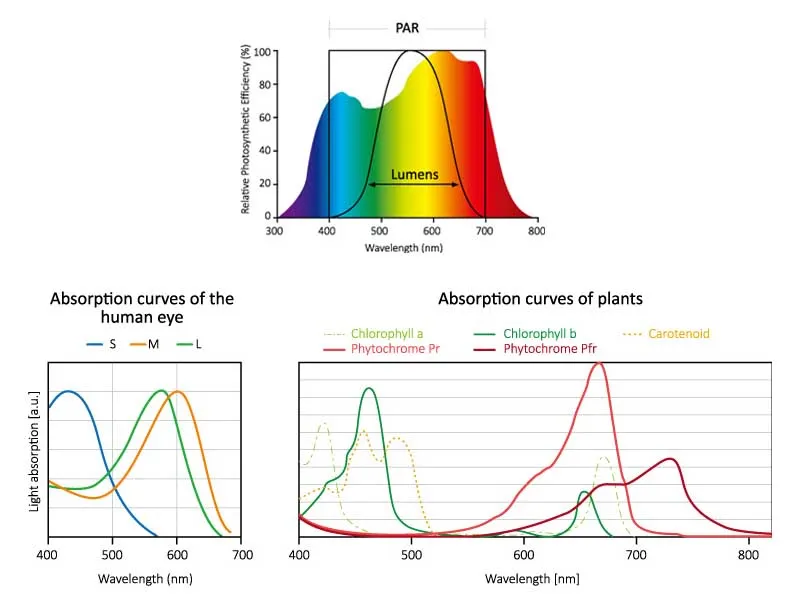
Photosynthetically Active Radiation (PAR) is not a conventional metric like feet, inches, or kilograms. Instead, it refers to a specific range of light wavelengths (400–700 nm) that plants utilize most effectively for photosynthesis. Through photosynthesis, plants convert light energy into chemical energy, which fuels their growth and survival. This process primarily involves chlorophyll a and b, which absorb and use light energy effectively within this range.
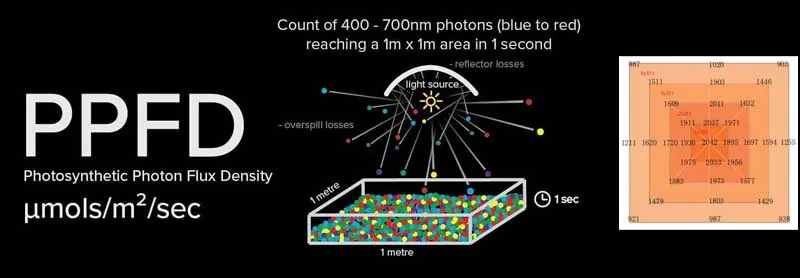
The PAR spectrum defines the light that plants use for photosynthesis, but it is measured using different metrics. One of the most common is Photosynthetic Photon Flux Density (PPFD), expressed in micromoles per square meter per second (μmol/s·m²). This metric helps quantify the amount of usable light falling on plants in the PAR range.
Traditional Lighting vs. Plant Lighting
Traditional Lighting (Lux and Lumens)
In traditional lighting systems, light intensity is measured in lux or lumens. These units describe how humans perceive light using the three receptors in our eyes (S, M, and L), which are most sensitive to blue, green, and yellow light. However, this measurement is not suitable for plant growth because plants respond differently to light than humans do. For instance, plants rely heavily on red and blue light for photosynthesis, which lux and lumens do not account for adequately.
Plant Lighting (PAR)
Plant lighting focuses on the PAR spectrum (400–700 nm), which is the range of light most effective for photosynthesis. Instead of lux, plant lighting uses PPFD to measure how much usable light is available for plants. This shift is essential for accurately assessing the performance of horticultural lighting systems, especially LED grow lights designed to optimize plant growth.
Key Metrics in PAR
When we talk about PAR (Photosynthetically Active Radiation), there are several important metrics that help us understand and measure the light plants use for photosynthesis. Let’s break these down in simple terms:
Photosynthetic Photon Flux (PPF)
PPF tells us how much light (in the PAR range) is produced by a grow light every second. Think of it as the total amount of “plant-usable” light a lamp emits. This is measured in micromoles per second (μmol/s).
-
Why It Matters:
Imagine you’re setting up grow lights in a greenhouse. PPF helps you figure out how many lights are needed for your crops. For instance, if you’re growing strawberries and need a total of 8000 μmol/s of light in a certain area, you can calculate how many lights you need based on each lamp’s PPF output. -
Limitations:
PPF doesn’t tell you how much of that light actually reaches your plants or how evenly the light is distributed. It’s just the total output, which means some of it might be wasted if it doesn’t hit the right spot.

Photosynthetic Photon Flux Density (PPFD)
PPFD is the next step. It measures how much of the light (from the PPF) actually lands on your plants. This is measured in micromoles per square meter per second (μmol/s·m²).
-
Why It’s Important:
PPFD is like the “final score” – it tells you how much usable light is reaching the plant canopy, where photosynthesis happens. If PPF is the total light emitted by a lamp, PPFD is how much of that light your plants actually get.For example, if you have two lamps with the same PPF but different designs or placements, their PPFD might vary a lot. One lamp might distribute light evenly, while the other might create “hot spots” (areas with too much light) or “shadows” (areas with too little light).
-
How to Use It:
When you’re comparing grow lights, PPFD is the metric you really want to focus on. It’s the best way to figure out which light will give your plants what they need.
Yield Photon Flux (YPF)
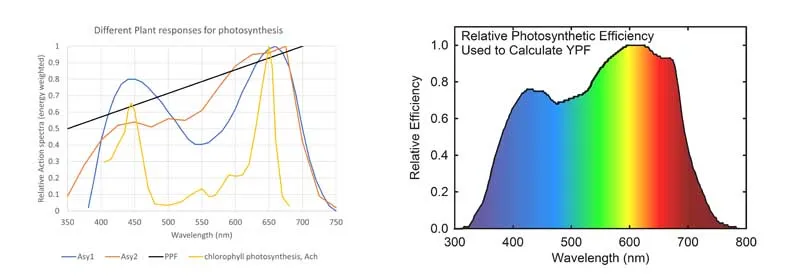
YPF is a more advanced version of PPF that considers the quality of light, not just the quantity. It weights the photons (light particles) in the PAR range based on how effective they are for photosynthesis.
-
In Simple Terms:
Not all light is equally useful to plants. Blue light (around 450 nm) and red light (around 660 nm) are the most effective for photosynthesis, while green light is less useful. YPF takes this into account by giving more “credit” to the photons plants like best. -
Why It’s Useful:
If you know your grow light emits a lot of blue and red light, it might perform better than a light with the same PPF but a different spectrum. YPF gives you a more realistic picture of how effective the light is for plant growth. -
Challenges:
The tricky part is that different plants and growth stages might prefer slightly different light spectrums. So while YPF is more accurate than PPF, it’s not always easy to apply universally.
Daily Light Integral (DLI)
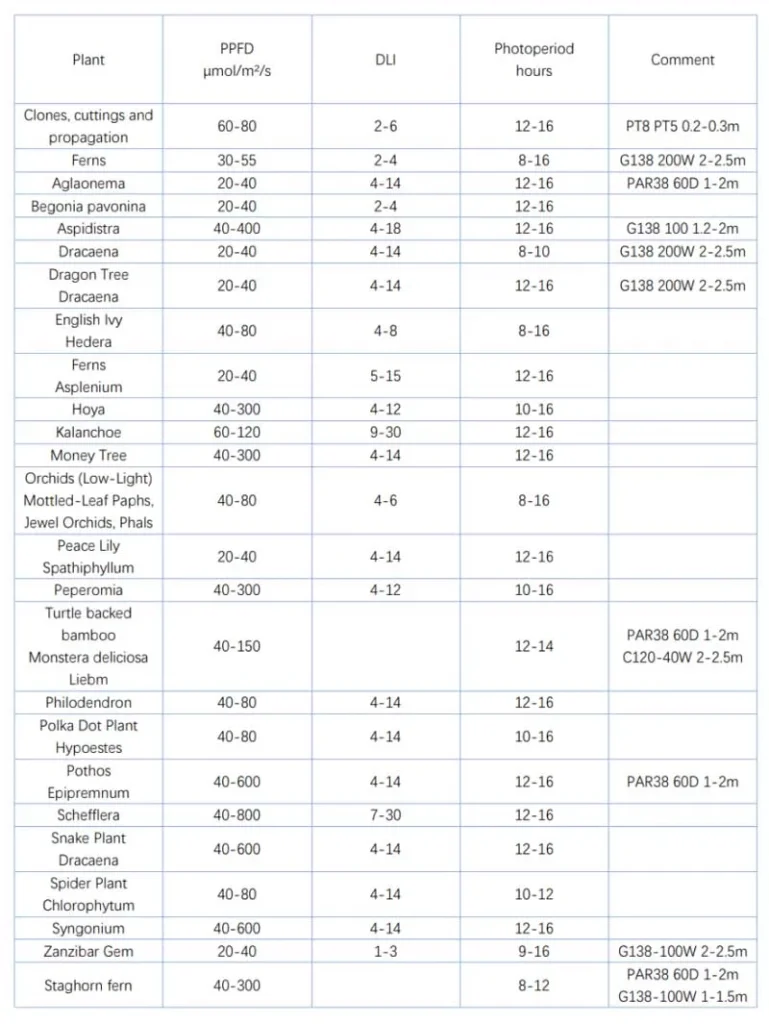
DLI measures how much total light your plants get over an entire day. It’s expressed in moles per square meter per day (mol/m²·d).
-
Think of It Like This:
If PPF and PPFD are snapshots of light at a single moment, DLI is the sum of all the light your plants receive throughout the day. It’s like adding up all the light “points” over a 24-hour period. -
Why It’s Important:
Plants don’t just need a certain intensity of light – they also need enough light over time to grow properly. DLI helps you figure out if your plants are getting the right “dose” of light each day.For example, a greenhouse with lots of natural sunlight might only need a little supplemental light to reach the ideal DLI. But in winter or indoors, you’ll need artificial lights to make up the difference.
-
How to Calculate It:
You can calculate DLI from PPFD by multiplying the light intensity by the number of hours the lights are on and then converting it to moles.
We wrote an article of this DLI topic before, please kindly check it >> Understanding Daily Light Integral (DLI) for Plant Growth
Photon Efficacy
Photon efficacy measures how efficiently a grow light turns electricity into PAR photons. It’s like the “fuel efficiency” of the lamp and is measured in micromoles per joule (μmol/J).
-
Why It Matters:
The higher the photon efficacy, the more light you get for every watt of electricity the lamp uses. This is great for saving energy and lowering costs. -
The Catch:
While photon efficacy tells you how energy-efficient a light is, it doesn’t tell you how effective it is for your plants. A highly efficient lamp might not produce the right spectrum for your crops, so you need to consider other metrics like PPFD and YPF as well.
Current Limitations in PAR Measurement
While PAR (Photosynthetically Active Radiation) is a useful concept for understanding plant lighting, the way we measure and use it today has some big limitations. Let’s dive into the main issues in a simple, straightforward way:
1. Treating All Photons Equally
One of the biggest problems with how we measure PAR is that we treat all photons (light particles) in the 400–700 nm range as if they’re equally useful to plants. But the truth is, plants don’t use all parts of the PAR spectrum in the same way.
-
What’s the Problem?
Imagine you’re eating a balanced diet. Some foods are more nutritious than others. Similarly, some parts of the light spectrum (like red and blue light) are more “nutritious” for plants because they drive photosynthesis more effectively. But current PAR measurements don’t consider this. A photon of green light is treated the same as red or blue, even though plants don’t use green light as efficiently. -
Why It Matters:
If you’re only looking at PAR numbers, you might think two lights are equally good for your plants. But if one light produces more red and blue photons, it will actually perform much better – even if the total PAR value is the same.
2. Ignoring Wavelengths Outside the PAR Range
PAR is limited to the 400–700 nm range because that’s the main light spectrum plants use for photosynthesis. But this ignores some important wavelengths outside of PAR, like far-red light (>700 nm) and ultraviolet light (<400 nm), which can also affect plant growth.
-
Far-Red Light (700–800 nm):
Far-red light doesn’t directly drive photosynthesis, but it plays a big role in plant development. For example, it can help plants stretch their stems, flower faster, or even boost yields in some crops. Studies have shown that adding far-red light to cucumber crops can increase yields by up to 24%! -
Ultraviolet Light (<400 nm):
UV light isn’t part of PAR either, but it can influence how plants grow. For example, UV light can trigger the production of certain compounds in plants, like antioxidants or pigments, which can improve their quality. -
The Problem with PAR:
Because these wavelengths aren’t included in PAR measurements, we often overlook their benefits when designing lighting systems. Growers who only focus on PAR might miss out on these extra advantages.
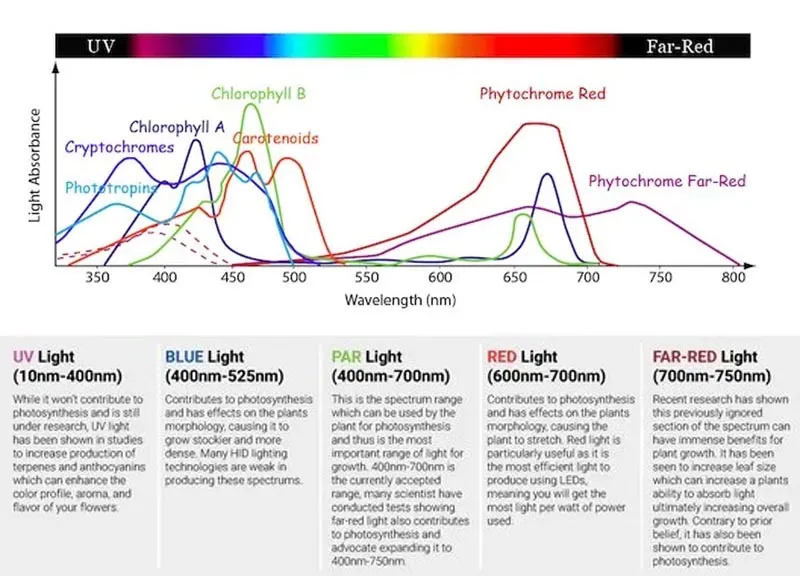
3. Not Considering Plant-Specific Needs
Another big limitation of PAR is that it assumes all plants respond to light the same way. But in reality, different plants – and even the same plant at different growth stages – have unique light requirements.
-
What’s the Problem?
A light spectrum that works great for leafy greens like lettuce might not be ideal for flowering plants like tomatoes or strawberries. For example:- Seedlings often need more blue light to grow strong, compact stems.
- Flowering plants benefit from more red light to boost blooms and fruit production.
Current PAR measurements don’t take these differences into account. They just provide a general idea of the light available for photosynthesis, without considering how well the light matches a specific plant’s needs.
4. Overlooking Light Distribution
PAR measurements, especially PPF (total light output), don’t tell us how the light is distributed over the plants. This can lead to uneven light coverage, with some plants getting too much light and others not enough.
-
Why It’s a Problem:
Imagine you’re watering a garden. If some areas get soaked and others stay dry, your plants won’t grow evenly. The same thing happens with light. Even if a grow light produces a high PAR value, it won’t be effective if the light isn’t spread evenly across the canopy. -
What’s Missing?
PAR measurements should be combined with information about how light is distributed (like PPFD maps) to give a more complete picture.
5. No Context for Efficiency or Spectral Quality
PAR measurements don’t tell us how efficiently a light source converts electricity into usable light or how good the light spectrum is for plants.
-
Efficiency:
A light might have a high PAR value, but if it uses a lot of electricity to produce that light, it’s not very efficient. Growers need to look at metrics like photon efficacy (μmol/J) to understand how energy-efficient a light is. -
Spectrum Quality:
PAR doesn’t account for how well the light matches the plant’s needs. For example, a light with a lot of green photons might have a high PAR value, but it won’t perform as well as a light with more red and blue photons.
6. Ignoring Environmental Factors
Finally, PAR measurements don’t consider how environmental factors, like greenhouse conditions or lamp placement, affect light absorption by plants.
For Example:
- Distance from Plants: If the lights are too far from the plants, much of the light will be lost before it reaches the canopy.
- Greenhouse Glass: In greenhouses, some light is blocked or scattered by the glass, which reduces the amount of PAR that actually reaches the plants.
These factors can significantly reduce the effectiveness of a lighting system, even if the PAR values look good on paper.
How Can We Improve PAR Measurements?
While PAR is a helpful concept, it’s clear that we need to go beyond simple PAR measurements to make better decisions about plant lighting. Here are some ideas for improvement:
-
Weighting Photons by Plant Sensitivity:
Instead of treating all photons equally, we should consider how plants respond to different wavelengths. For example, red and blue photons should be given more weight than green photons to reflect their higher importance in photosynthesis. -
Including Wavelengths Outside PAR:
Add far-red and UV light into the equation, especially for plants that benefit from these wavelengths. -
Plant-Specific Metrics:
Develop better tools to match light spectrums with specific crops and growth stages. This would help growers optimize their lighting systems for each plant’s unique needs. -
Focus on Light Distribution:
Combine PAR measurements with PPFD maps and other tools to ensure even light coverage across the plant canopy. -
Energy and Spectrum Efficiency:
Look at metrics like photon efficacy and spectrum quality alongside PAR to get a more complete picture of a light’s performance.
Improving Lighting Efficiency
1. Optimizing Light Distribution
Efficient light distribution ensures uniform coverage over the plant canopy. Uneven light can cause fluctuations in growth and reduce crop yield. Advanced optical controls, such as Totally Internal Reflection (TIR) lenses, help focus light directly on plants, reducing waste and increasing penetration into lower canopy layers.
2. Reducing Light Spill
Light spill occurs when energy from grow lights is wasted on areas outside the plant canopy. This issue is more pronounced in greenhouses with high ceilings. Optimizing beam angles and using diffuse glass can help minimize light spill and improve overall PPFD values.
PAR is the foundation of horticultural lighting, but it must be evaluated alongside metrics like PPFD, YPF, and DLI for a comprehensive understanding of plant lighting efficiency. Current PAR measurement methods have limitations, such as equal photon weighting and the exclusion of non-PAR wavelengths. However, advancements in lighting design, spectral optimization, and energy efficiency promise to revolutionize plant lighting. By tailoring light systems to crop-specific needs and improving distribution, we can maximize photosynthetic efficiency, reduce energy waste, and increase yields.
Key Points:
- PPF tells you the total light output of a lamp.
- PPFD shows how much of that light actually reaches your plants.
- YPF adjusts for how useful the light spectrum is for photosynthesis.
- DLI looks at the total light your plants get over a day.
- Photon Efficacy helps you evaluate the energy efficiency of the grow light.
To choose the best lighting system, you need to consider all of these factors. For example, a light with high PPF but poor distribution (low PPFD) won’t help your plants as much. Similarly, a highly efficient light (high photon efficacy) might not work well if it doesn’t emit the right spectrum for your crops.
